
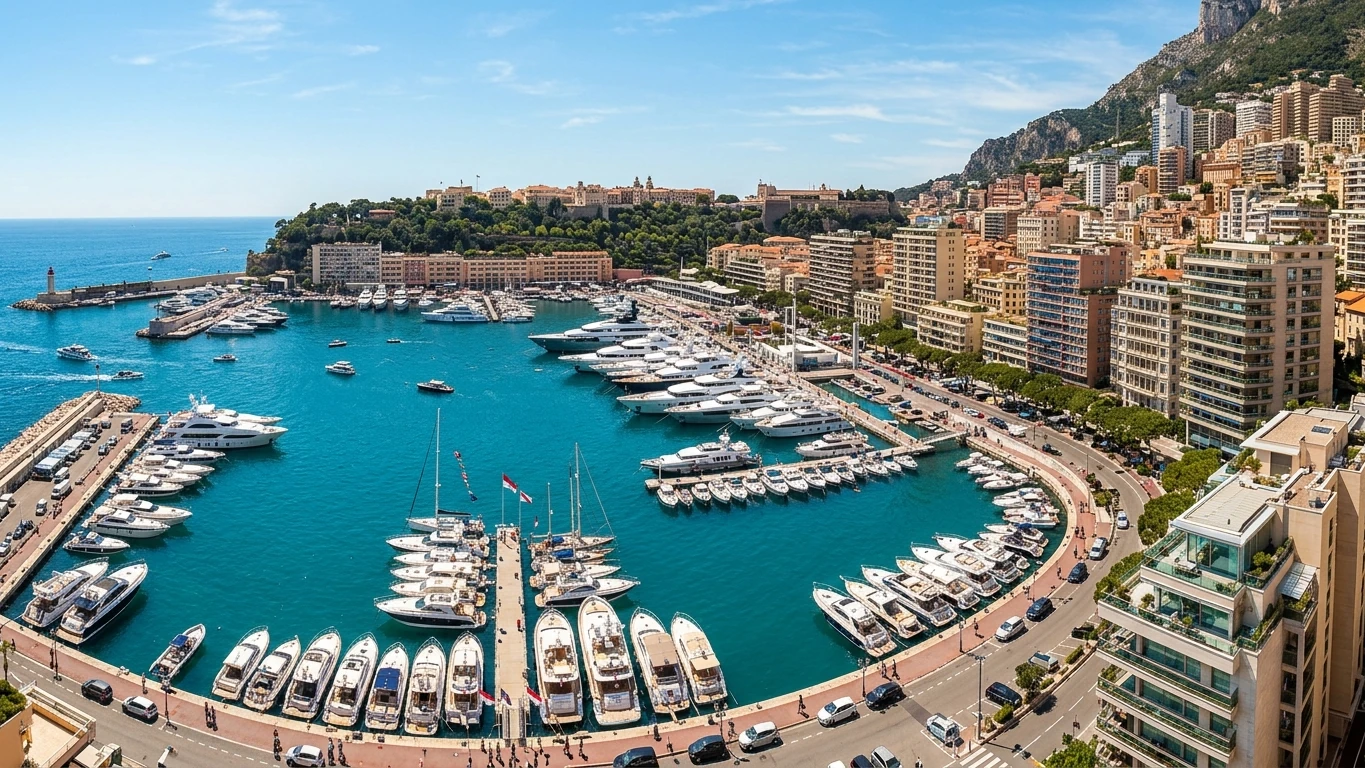
When advising international families from our offices in Switzerland, Monaco is the jurisdiction that sits most frequently alongside Zurich and Geneva on the family balance sheet. Yet prospective clients often misunderstand what the Monégasque banking sector actually is. Monaco does not have a retail banking market for foreign non-residents, nor does it have its own independent central bank printing a local currency. The Principality is a specialized private wealth enclave managing roughly EUR 165 billion in client assets across fewer than thirty licensed credit institutions and sixty portfolio management companies.
For high-net-worth individuals planning a relocation to the Côte d’Azur or diversifying custody between the Swiss Franc and the Eurozone, understanding how Monte Carlo banks are regulated and how their compliance committees evaluate foreign files is essential. Our practice coordinates both Swiss custody and Monégasque banking introductions through our international non-resident private bank account introduction so clients do not trigger duplicate compliance inquiries across parent and subsidiary banks.
Monetary Architecture: How ACPR, CCAF, and SICCFIN Govern Monaco Banks
Although Monaco is a sovereign principality outside the European Union, its banking system is legally integrated into the Eurozone and the Single Euro Payments Area (SEPA) through bilateral conventions with France, specifically the Franco-Monégasque Monetary Agreement and the banking exchange of letters dating back to 1945 and modernized under EU monetary treaties. Every bank operating in Monte Carlo clears in Euros through the Banque de France and issues Monégasque IBANs beginning with the prefix MC.
Because of this monetary union, banking supervision in Monaco is split across three bodies. Prudential licensing, capital adequacy ratios, and liquidity supervision are enforced directly by the French banking regulator, the Autorité de Contrôle Prudentiel et de Résolution (ACPR), alongside the European Central Bank framework. Cash deposits held at Monaco banks are covered by the French deposit guarantee fund, the Fonds de Garantie des Dépôts et de Résolution (FGDR), up to EUR 100,000 per client per institution.

Inside the Principality itself, investment and wealth management activities—such as discretionary portfolio management, advisory mandates, and multi-family office services—are licensed and policed by the Commission de Contrôle des Activités Financières (CCAF) under Law No. 1.338. Meanwhile, anti-money laundering and counter-terrorist financing enforcement rests with the Service d’Information et de Contrôle sur les Circuits Financiers (SICCFIN), supplemented by the professional standards of the Association Monégasque des Activités Financières (AMAF). Following extreme scrutiny from the Council of Europe’s MONEYVAL committee and the FATF between 2023 and 2026, SICCFIN conducts aggressive on-site inspections of private bank compliance files. As a result, a Monte Carlo compliance officer today is every bit as forensic when auditing a foreign client’s tax history and corporate trail as a compliance officer in Zurich.
Major Private Banks in Monaco: 2026 Asset Minimums and Institutional Profiles
Look down the Boulevard des Moulins or Around the Carré d’Or in Monte Carlo and you will recognize almost every nameplate from Paradeplatz and Rue du Rhône. Over half of the private banks operating in Monaco are subsidiaries of Swiss banking groups, joined by Monégasque flagship banks, French banking groups, and Liechtenstein’s LGT. When comparing these institutions against evaluating the safest Swiss banks by tier-1 capital and credit ratings, clients should examine both parent-group capitalization and local Monégasque lending appetite.
| Institution in Monaco | Parent Group & Head Office Origin | Non-Resident Onboarding Minimum (2026) | Residency Attestation (Carte de Séjour) Policy | Core Institutional Strength |
|---|---|---|---|---|
| CFM Indosuez Wealth Management | Crédit Agricole Group (France / Monaco founded 1922) | EUR 1,000,000 – EUR 2,000,000 | EUR 500,000 – EUR 1,000,000 | Largest employer in Monaco banking; commercial banking, yacht/real estate credit, and private wealth |
| CMB Monaco (Compagnie Monégasque de Banque) | Mediobanca Group (Italy / Monaco) | EUR 1,000,000 – EUR 2,500,000 | EUR 500,000 – EUR 1,000,000 | Dedicated Monaco private bank with strong local real estate financing and Lombard lending |
| Bank Julius Bär (Monaco) S.A.M. | Julius Bär Group (Zurich, Switzerland) | EUR 2,000,000 – EUR 3,000,000 | EUR 1,000,000+ | Pure-play Swiss wealth management, multi-currency advisory, and family office structuring |
| UBS (Monaco) S.A. | UBS Group AG (Zurich, Switzerland) | EUR 2,000,000 – EUR 5,000,000 | EUR 1,000,000 – EUR 2,000,000 | Global investment banking access, institutional custody, and Lombard credit lines |
| Banque J. Safra Sarasin (Monaco) SA | J. Safra Sarasin Group (Basel, Switzerland) | EUR 2,000,000+ | EUR 1,000,000+ | Conservative balance sheet, high Tier-1 capital, and international UHNW family custody |
| Edmond de Rothschild (Monaco) | Edmond de Rothschild Group (Geneva, Switzerland) | EUR 2,000,000+ | EUR 1,000,000+ | Private equity co-investments, European real estate advisory, and dynastic wealth planning |
| Société Générale Private Banking (Monaco) & BNP Paribas WM | Société Générale / BNP Paribas (Paris, France) | EUR 1,000,000+ | EUR 500,000 – EUR 1,000,000 | Integrated European corporate/private banking and French/Monégasque property mortgages |
The Monaco Residency Attestation (Attestation Bancaire) for the Carte de Séjour
Unlike Switzerland, where a wealthy non-EU national obtains residency by negotiating a cantonal lump-sum tax ruling (forfait fiscal) before applying for a B permit, Monaco grants residency primarily on the basis of accommodation and a local bank attestation. Because Monaco levies zero personal income tax, zero capital gains tax, and zero net wealth tax on residents (with the well-known exception of French nationals under the 1963 bilateral convention), the Sureté Publique relies on Monaco’s private banks to act as the financial gatekeeper for residency applications.
To apply for a Monégasque Carte de Séjour without a local employment contract or active business license, the applicant must present an official attestation bancaire issued by a licensed bank in Monaco confirming that the applicant holds sufficient funds on deposit in the Principality to sustain their lifestyle. For years, the statutory minimum cited by the authorities was EUR 500,000. In practice, following AMAF guidance and higher compliance overheads, almost every private bank in Monte Carlo now requires a minimum deposit of EUR 1,000,000—and at several Swiss subsidiaries EUR 2,000,000—before signing a residency attestation letter.

There is a practical sequencing rule that catches relocating clients by surprise. You cannot simply walk into CFM Indosuez or CMB Monaco on Monday, wire EUR 1 million on Tuesday, and pick up your residency attestation on Wednesday. The bank will not issue the attestation until its full AML compliance committee has approved your onboarding, received the cleared EUR 1 million into an active account, and reviewed your registered 12-month Monaco apartment lease or property purchase deed. Because Monaco landlords often ask for local banking references before signing a lease, we coordinate the bank’s compliance pre-clearance in advance so the account opens the week the lease is executed.
Monaco vs. Switzerland: Where Should Non-Resident HNWIs Custody Their Wealth?
When clients have no immediate plans to take up physical residency in Monte Carlo, we candidly advise them to weigh the structural trade-offs between opening a Swiss bank account as a non-resident foreigner and booking assets in Monaco. Both centers offer identical access to global equities, fixed income, structured notes, and Lombard credit, often within the exact same banking group.
The difference lies in sovereign monetary jurisdiction and regulatory reporting. Assets booked in Zurich or Geneva sit outside the European Union and outside the Eurosystem, governed by the Swiss National Bank, FINMA, and the Swiss Federal Banking Act. Assets booked in Monaco sit inside the Eurozone clearing architecture under French ACPR prudential oversight. For an entrepreneur whose operating wealth is already concentrated in Eurozone real estate or EU corporate holdings, booking liquid reserves in Switzerland provides true currency and regulatory diversification outside the Brussels and Paris supervisory perimeter. Conversely, if a client is buying a villa in Cap-d’Ail, financing a yacht berthed in Port Hercule, or preparing a Monaco residency file, a Monte Carlo private bank provides local credit execution and mortgage structuring—often by pledging the client’s liquid portfolio via a Lombard facility at 50 to 70 percent loan-to-value—that a Zurich desk will not underwrite directly.
In terms of cost and minimum thresholds, both centers sit in the same bracket. As we detail in our breakdown of minimum deposit thresholds at Swiss private banks, all-in custody and advisory fees in both Monte Carlo and Geneva typically run between 0.65 percent and 1.25 percent per annum on portfolios between EUR 1 million and EUR 5 million. However, SICCFIN’s post-2024 compliance regime in Monaco is particularly rigid regarding payments to non-EU offshore jurisdictions; clients with complex multi-jurisdictional family trusts often find that Swiss compliance officers have deeper technical familiarity with Anglo-Saxon trust law and Liechtenstein foundations than local desks in Monaco.