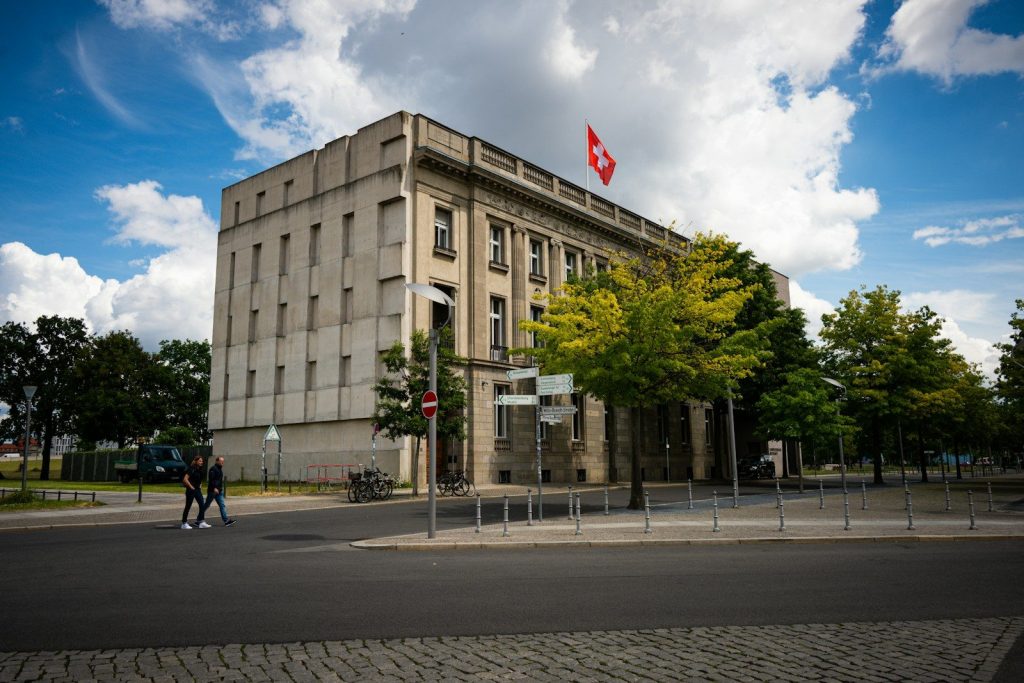

Swiss private banking has a reputation built over two centuries, but the reputation and the reality are no longer the same thing. Banking secrecy towards tax authorities has gone, Hong Kong has caught up as a cross-border centre, and the number of private banks keeps shrinking. Yet the numbers show an industry at a record: banks in Switzerland managed CHF 9,729 billion at the end of 2025, according to the Swiss Bankers Association, and more than CHF 10,000 billion by mid-2026.
We place international clients with Swiss private banks every week. In this guide we test the classic advantages of Swiss private banking against current data, explain what has changed and show who benefits most. You can check your own fit with the self-assessment below.
Swiss private banking: key figures
- Assets under management at banks in Switzerland: CHF 9,729 billion at the end of 2025, above CHF 10,000 billion in H1 2026 (Swiss Bankers Association).
- Cross-border private client assets: CHF 2,945.7 billion in 2025, up 7.6% currency-adjusted (Swiss Bankers Association).
- Aggregate net income of banks in Switzerland: a record CHF 73.8 billion in 2025, up 5.8% (Swiss Bankers Association).
- Tax transparency: 116 partner states under the automatic exchange of information in August 2026 (State Secretariat for International Finance, via RegFollower).
1. Swiss private banking in numbers
Put simply, the industry has never been larger. In 2025, assets under management at banks in Switzerland grew by 4.8% to a record, and aggregate net income rose by 5.8% to CHF 73.8 billion. Cross-border wealth management for private clients, the core of Swiss private banking, reached CHF 2,945.7 billion.
Practitioner Note: This analysis is part of BMA Business Solutions’ cross-border practice on non-resident bank account opening in Switzerland and international banking hubs. For bespoke compliance evaluation and structural guidance, contact our senior advisory desk.
Cross-border private client assets managed in Switzerland (CHF bn)
Source: Swiss Bankers Association, Banking Barometer 2025 (28 August 2025) and 2026 (31 August 2026). The 2025 growth rate of 7.6% is currency-adjusted; the reported totals are not directly comparable year on year.
Total assets under management at banks in Switzerland (CHF bn)
Source: Swiss Bankers Association, Banking Barometer 2026 and media release of 31 August 2026.
At the same time, however, the industry is consolidating. KPMG reported that the number of Swiss private banks fell below 80 in 2025, and banks in Switzerland employed 92,002 people at the end of 2025, 2.5% fewer than a year before. In other words, fewer banks and fewer staff now manage more money.
| Indicator | Value | Date | Source |
|---|---|---|---|
| Assets under management, all banks in Switzerland | CHF 9,729 bn | End 2025 | Swiss Bankers Association |
| Cross-border private client assets | CHF 2,945.7 bn | 2025 | Swiss Bankers Association |
| Aggregate net income of banks | CHF 73.8 bn | 2025 | Swiss Bankers Association |
| Bank employees in Switzerland (FTE) | 92,002 | End 2025 | Swiss Bankers Association |
| Assets of Swiss private banks | about CHF 3.5 tn | 2025 | KPMG |
| Number of private banks | below 80 | 2025 | KPMG |

2. Advantage one: stability of the country and the currency
First of all, political and monetary stability remain the strongest argument. Switzerland has a direct democracy, a federal structure and an independent central bank. The Swiss franc has kept its role as a safe-haven currency, and the SNB policy rate has been at 0% since June 2025.
For an international client, therefore, this means a second anchor for part of their wealth: a currency and a legal system that do not move with their home country. The Swiss Bankers Association noted that cross-border inflows are especially strong in times of geopolitical uncertainty, which is exactly when clients value that anchor most.
The franc itself deserves a word of caution, though. A strong currency protects wealth in a crisis, but it also makes Swiss assets expensive for clients whose spending is in euros or dollars. For that reason, most of our clients hold only part of their Swiss portfolio in francs and keep the rest in the currencies they actually spend. Swiss banks make that easy, because almost every account is multi-currency by default.
3. Advantage two: depth of expertise and choice of banks
Secondly, Switzerland offers a range of banks that few centres can match: one global bank, 24 cantonal banks, dozens of private banks and many foreign banks. That choice lets a client find a bank that fits their size, country and needs rather than accepting whatever is on offer.
| Bank type | Number (SIF, 2024) | What they offer private clients |
|---|---|---|
| Big bank (UBS) | 1 | Global platform, full product range |
| Cantonal banks | 24 | Mostly domestic clients; some serve international clients |
| Private banks and private bankers | Below 80 (KPMG, 2025) | Specialist wealth management, personal service |
| Foreign banks in Switzerland | Many | Access to their home markets and networks |
| Raiffeisen and regional banks | 1 group, 58 regional | Mainly domestic retail and mortgages |
4. Advantage three: client asset protection
Thirdly, Swiss law keeps client securities separate from a bank’s own assets. If a bank fails, shares, bonds and funds in custody are handed back to the client rather than shared among creditors. Cash deposits are protected up to CHF 100,000 per client and bank.
This is also why wealthy clients hold most of their Swiss assets as securities rather than cash. Our guide on checking Swiss bank safety explains how to read a bank’s capital and liquidity figures before you choose it.

Custody segregation does not remove every risk, of course. Market losses, poor advice and high fees can still erode a portfolio. That is why the choice of bank and mandate matters as much as the legal protection.
5. What changed: Swiss private banking and tax transparency
By far the biggest change, however, is tax transparency. Since 2018, Switzerland has exchanged account data automatically with its partner states. In August 2026, it had 116 partner states under the Common Reporting Standard, although exchange with Russia is suspended. In its latest exchange, the Federal Tax Administration sent information on about 3.4 million accounts.
| Then | Now |
|---|---|
| Banking secrecy protected clients from foreign tax authorities | Account data is sent automatically to the client’s country of tax residence |
| Undeclared money was common | Banks accept only tax-compliant clients |
| Discretion was the main selling point | Stability, service and expertise are the selling points |
| Few questions about the source of funds | Detailed source-of-wealth checks |
Even so, banking secrecy has not disappeared entirely. Swiss law still makes unauthorised disclosure of client data to private third parties a criminal offence. What it no longer does is shield clients from their own tax authorities. For honest clients, this change makes Swiss private banking simpler, not harder.
6. Advantage four: services beyond the account
Fourthly, Swiss private banks offer more than custody and investments. In our experience, three services matter most to international clients.
- Lombard loans: credit secured on the portfolio, often used for property purchases or business needs without selling investments.
- Multi-currency banking: accounts, cards and payments in CHF, EUR, USD and other currencies under one roof.
- Wealth planning: succession, trusts, foundations and coordination with advisers in several countries.
7. Is Swiss private banking right for you?
Naturally, Swiss private banking suits some clients much better than others. Tick what applies to you:
Swiss private banking: is it right for you?
A quick self-assessment based on the reasons our clients choose Swiss private banking. The last point is a precondition: Swiss banks only accept tax-compliant clients.
Note that the last point is not optional. Swiss banks only open accounts for clients who can show that their assets are declared at home. If that is in place and most other points apply, Switzerland is likely to be a good fit. For a general introduction, see our guide on what private banking is, and for practical tiers, our guide to minimum balances at Swiss banks.
8. The competition: Hong Kong, Singapore and others
Admittedly, Switzerland no longer leads alone. BCG reported that Hong Kong narrowly overtook Switzerland as the largest cross-border wealth centre in 2025, with both at about USD 2.9 trillion. Singapore follows with about USD 2.1 trillion.
Still, for clients from Europe, the Middle East, Latin America and the CIS region, Switzerland remains the natural first choice because of time zone, language, legal tradition and the range of banks. For clients whose business and family are in Asia, Hong Kong or Singapore may fit better. Our comparison of Switzerland and Singapore for wealthy clients covers the trade-offs.
9. What Swiss private banking costs
Swiss private banking is not cheap, and it is rarely priced as a single number. Typically, a bank charges a fee for advice or management as a percentage of assets, a custody fee, and transaction costs. On top of that, funds and structured products carry their own costs inside the product.
| Cost element | How it is charged | What to ask |
|---|---|---|
| Management or advisory fee | Percentage of assets per year | Is it all-in, or are custody and trading extra? |
| Custody fee | Percentage of assets, sometimes with a minimum | Is there a minimum annual fee? |
| Transaction costs | Per trade or included in an all-in fee | How many trades does the mandate usually make? |
| Product costs | Inside funds and structured products | Does the bank use its own products, and what do they cost? |
| Account and card fees | Flat fees | Are they waived above a certain size? |
In our experience, the all-in cost in percent per year is the only number that allows a fair comparison. Therefore, we ask every bank for it in writing, including product costs. Larger portfolios usually get lower rates, so it also pays to concentrate assets at one or two banks rather than spreading them thinly.
10. How to choose a Swiss private bank
Choosing a bank is more than picking a famous name. First, check that the bank serves clients from your country of residence, because cross-border rules limit many banks. Next, consider whether your assets will make you an important client there; CHF 2 million matters at a boutique bank and much less at a global one.
After that, look at stability and service. A bank’s published capital ratios, its ownership and its profitability tell you how solid it is. Meanwhile, the quality of the relationship manager, and how long they are likely to stay, often decides how satisfied you will be in practice. Our guide on how we choose a Swiss bank for non-residents sets out the full process.
Methodology and data notes
We used primary sources and dated each figure. Industry data comes from the Swiss Bankers Association’s Banking Barometer 2025 and 2026, private bank data from KPMG, the bank count from the SIF key figures, and tax exchange data from the Federal Tax Administration and the SIF partner list.
Note that the cross-border asset totals for 2024 and 2025 are reported in different ways, so the change between them is not simply the growth rate. Entry levels and service observations reflect our own experience. Finally, this guide is general information and not investment or tax advice.
Swiss private banking: frequently asked questions
Size, secrecy and competition
What is Swiss private banking?
Swiss private banking is wealth management and banking for wealthy clients provided by banks in Switzerland, usually through a dedicated relationship manager. It combines accounts in several currencies, portfolio management, Lombard lending and wealth planning.
How big is Swiss private banking?
Banks in Switzerland managed a record CHF 9,729 billion at the end of 2025 and passed CHF 10,000 billion in the first half of 2026. Cross-border private client assets reached CHF 2,945.7 billion in 2025, according to the Swiss Bankers Association.
Does Swiss banking secrecy still exist?
Yes, towards private third parties: Swiss law still makes unauthorised disclosure of client data a criminal offence. It no longer shields clients from their own tax authorities, because Switzerland exchanges account data automatically with more than 100 partner states.
Is Switzerland still the largest cross-border wealth centre?
Not by a clear margin. BCG reported that Hong Kong narrowly overtook Switzerland in 2025, with both at about USD 2.9 trillion of cross-border wealth. The Swiss Bankers Association still describes Switzerland as among the world leaders.
Access, tax reporting, safety and cost
How much money do I need for Swiss private banking?
There is no legal minimum. In our experience, most Swiss private banks start at about CHF 500,000 to CHF 1 million, and more for clients from higher-risk countries. Our guide to minimum balances shows the tiers.
Which countries does Switzerland exchange tax data with?
Switzerland had 116 partner states under the automatic exchange of information in August 2026, although exchange with Russia is suspended. In the latest exchange, the Federal Tax Administration sent data on about 3.4 million accounts.
Are Swiss private banks safe?
Most are well capitalised, and client securities are kept separate from the bank’s own assets. Cash deposits are protected up to CHF 100,000 per client and bank. Check each bank’s published key metrics before you commit.
What does Swiss private banking cost?
Most banks charge a percentage of assets for advice or management, plus custody and transaction fees. Compare the all-in cost in percent per year, including product costs, rather than the headline fee.
Sources
- Swiss Bankers Association, Banking Barometer 2026: wealth management
- Swiss Bankers Association, Swiss banking sector expects further growth after record year (31 August 2026)
- Swiss Bankers Association, Banking Barometer 2026: number of staff
- Swiss Bankers Association, Banking Barometer 2025 press release (28 August 2025)
- KPMG, Swiss private banks: record assets, but lower profits (24 June 2026)
- SIF, Key figures on the Swiss financial sector 2026
- Federal Tax Administration, AEOI: exchange of information with 101 countries
- RegFollower, Switzerland updates list of AEOI partner jurisdictions (August 2026)
- BCG, Hong Kong surpasses Switzerland as largest cross-border wealth hub (27 May 2026)