
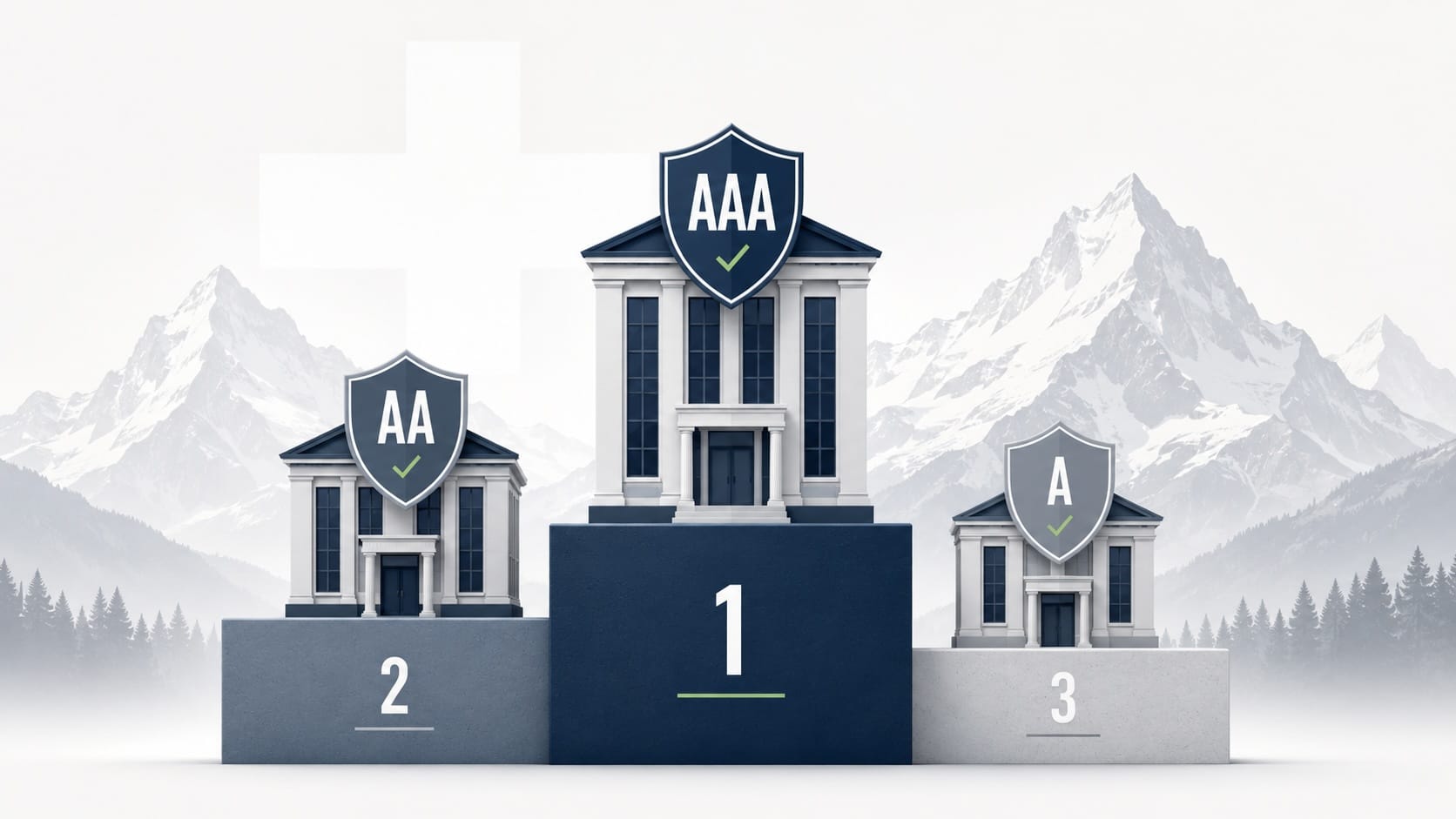
Looking for the safest Swiss banks? Here is the short answer. The single safest bank by credit rating is Zürcher Kantonalbank, the only Swiss bank that holds a top AAA from all three major agencies. Right behind it sit the other cantonal banks, which carry a guarantee from their canton. The big names you know — UBS, Pictet, Julius Baer — are strong too, just a notch or two lower.
But a credit rating is only half the safety story. The other half is the deposit guarantee that protects up to CHF 100,000 of your money at every licensed bank in the country. Both layers matter, and most lists explain only the first. This guide ranks the safest Swiss banks by current rating, then shows how the guarantee and a few other protections actually keep your deposits safe.
Zürcher Kantonalbank holds AAA from all three agencies. Deposit protection covers CHF 100,000 per client per bank. Four banks are designated systemically important. Around 230 banks operate in Switzerland as of end-2024.
The safest Swiss banks by credit rating in 2026
A credit rating measures one thing: how likely a bank is to repay what it owes. The top grade is AAA (or Aaa at Moody’s). Anything from BBB− and above counts as investment grade, and almost every notable Swiss bank sits comfortably inside that band. So the question is not really “is this bank safe,” but “how safe, and why.”
The table below ranks the most prominent rated banks, safest first. We pulled each rating from the agencies and the banks’ own investor pages. One caveat up front: ratings change, so treat this as a mid-2026 snapshot and confirm anything critical with the agency directly.
How did we order the safest Swiss banks here? We started with the long-term issuer or deposit rating from S&P, Moody’s and Fitch. Then we weighed the structural backing behind each bank, such as a cantonal guarantee, federal ownership, or systemically important status. A grade on its own can mislead. So the ranking reflects both the rating and what genuinely stands behind it.
| Bank | S&P | Moody’s | Fitch | Why it ranks here |
|---|---|---|---|---|
| Zürcher Kantonalbank | AAA | Aaa | AAA | Only triple-A Swiss bank; Canton of Zurich guarantee |
| Basler Kantonalbank | AA+ | – | AAA | Cantonal guarantee (Basel-Stadt) |
| Banque Cantonale Vaudoise | AA | Aa2 | – | Cantonal guarantee (Vaud) |
| UBS AG | A+ | Aa2 | A+ | Operating bank; systemically important |
| Pictet | – | Aa2 | AA− | Large, conservatively run private bank |
| Raiffeisen Schweiz | AA− | Aa3 | A+ | Systemically important; cooperative group |
| LGT Bank | A+ | Aa2 | – | Owned by the Princely House of Liechtenstein |
| Lombard Odier | – | – | AA− | Long-established Geneva private bank |
| Bank Vontobel | – | Aa3 | – | Deposit rating; holding company rated lower |
| EFG International | – | A1 | A | International private bank |
| Julius Baer | – | A1 | – | Downgraded from Aa3 after 2024 credit losses |
Two things stand out. First, the safest Swiss banks at the very top are not the famous global names — they are cantonal banks. Second, Julius Baer shows that ratings move. Moody’s cut it from Aa3 to A1 after the bank booked heavy losses on private-debt exposure in 2024. That is a useful reminder. A rating reflects today, not forever.
Why cantonal banks top the safest Swiss banks list
Here is the part most ranking lists skip. A cantonal bank is partly owned by its canton, and in most cases the canton legally guarantees its liabilities. That state guarantee is exactly why Zürcher Kantonalbank earns a triple-A. On its own merits, ZKB rates around aa− — already excellent. The Canton of Zurich’s own AAA standing then lifts it to the top grade.
This matters more than headline size. A small cantonal bank with a full state guarantee can be a safer home for your cash than a far larger private bank without one. Switzerland has 24 cantonal banks, and most carry some form of cantonal backing. Not all of them are separately rated, because many never issue bonds and so never need a public rating. Their safety comes from the guarantee, not from a letter grade.
This is why the safest Swiss banks list looks upside-down next to the famous-name rankings. The institutions with the most protection are local, not global. A canton cannot print money, of course. Yet a Swiss canton is a stable, low-debt government, and its backing is a real legal promise rather than a marketing line. That promise is what pushes a modest cantonal bank above a household name.
So if pure safety is your goal, start with a state-guaranteed cantonal bank in a financially strong canton. Zurich, Basel, Vaud and Geneva are obvious examples. You give up some of the international service and private-banking polish of a Pictet or a UBS. In return, you get a balance sheet that a cantonal government stands behind.

What happened to UBS and Credit Suisse?
If you are comparing older lists, you will still see Credit Suisse. Ignore those entries. Credit Suisse no longer exists as a bank. UBS absorbed it in stages and merged the legal entities one by one. The authorities deregistered Credit Suisse AG on 31 May 2024, and Credit Suisse (Schweiz) AG followed into UBS Switzerland AG on 1 July 2024. Any “Credit Suisse credit rating” you find today is purely historical. That scale, by the way, is also why UBS does not top our safest Swiss banks ranking. Size is not the same as protection.
That leaves UBS as Switzerland’s lone global giant. Its ratings deserve a quick clarification, because even some 2026 lists get this wrong. S&P rates the operating bank, UBS AG, at A+, with Aa2 from Moody’s and A+ from Fitch. The holding company above it, UBS Group AG, is rated a notch or two lower. For a depositor, the operating bank is the entity that matters, so UBS AG is the rating to look at. Moody’s reaffirmed it in late 2025 with a stable outlook, citing solid progress on the integration.
Credit ratings tell you how a bank is doing. Deposit protection tells you what happens if it fails anyway. And this is the fact the old “safest banks” lists almost always bury. In Switzerland, the esisuisse scheme protects up to CHF 100,000 per client, per bank. Every bank with a Swiss licence belongs to it. So the very first layer of safety is identical at a tiny regional bank and at UBS.
There is more behind that number. The law also treats deposits up to CHF 100,000 as “privileged” claims in a bankruptcy, so they rank ahead of most other creditors. The scheme even pays out a portion quickly from the failed bank’s liquid assets. For most personal savers, that combination matters more than the gap between AA and AAA. If your balance sits under CHF 100,000, you are protected at any licensed Swiss bank regardless of its rating.
What if you hold more than CHF 100,000? Then the rating and the guarantee structure start to count. The simplest move is to spread larger sums across more than one bank, so each slice stays within the protected limit. Wealthy clients often combine a state-guaranteed cantonal bank for cash with a private bank for investments. That way the safe core is genuinely safe, and the rest is invested where the service fits.
Systemically important banks: too big to fail
One more layer sits above deposit protection. Switzerland designates a handful of banks as “systemically important,” meaning their failure would threaten the whole economy. These banks face stricter capital and liquidity rules, and the state has strong reasons to keep them standing. Four institutions currently hold this status: UBS, Zürcher Kantonalbank, Raiffeisen and PostFinance.
That label is not a personal guarantee, and the 2023 Credit Suisse rescue showed the regime under real strain. Still, it signals where the regulator’s attention is concentrated. Notice the overlap, too. ZKB and Raiffeisen appear on both the top-rating list and the systemically important list. For a cautious saver, that double qualification is about as reassuring as Swiss banking gets.
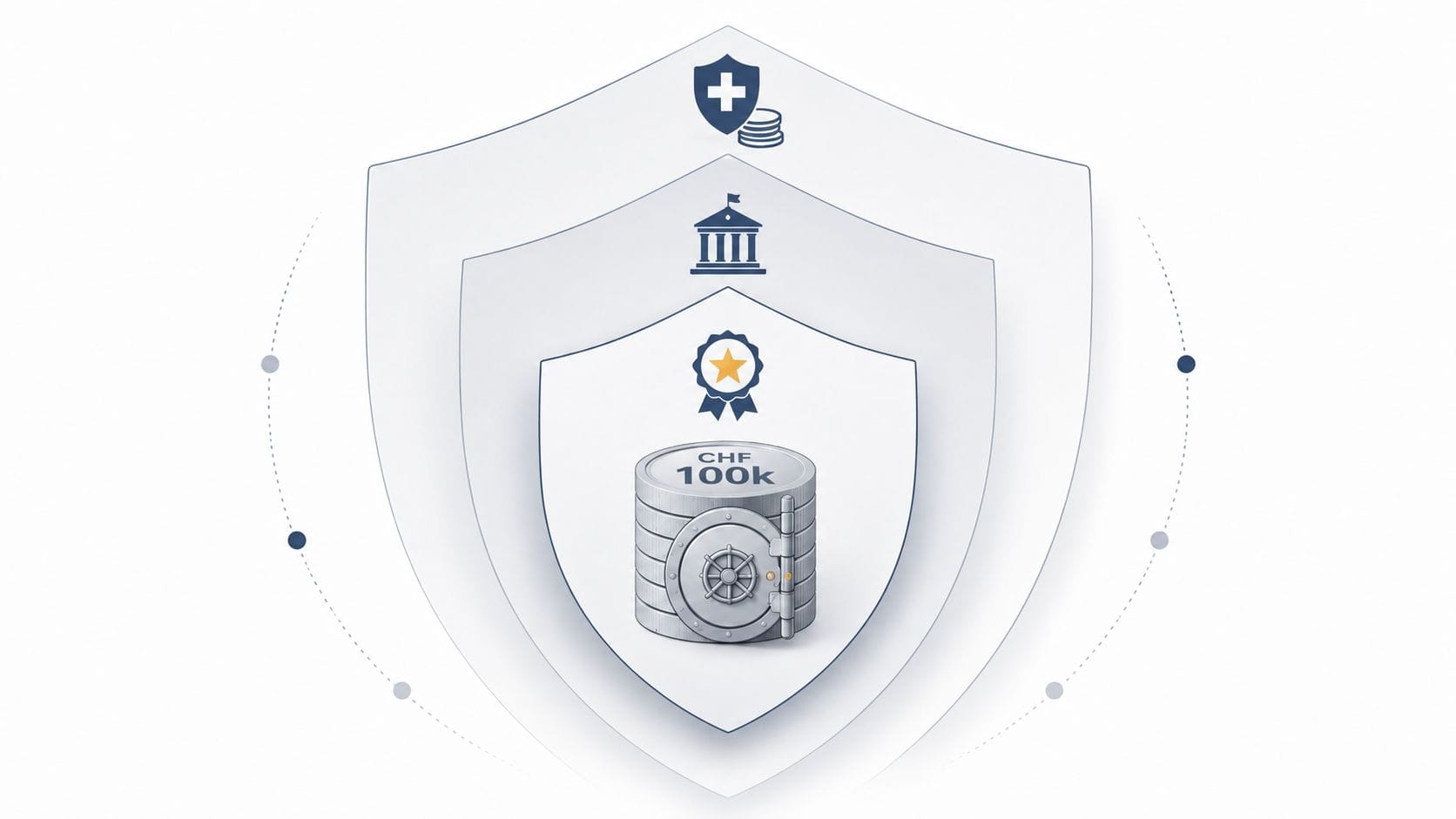
Every licensed bank carries esisuisse protection up to CHF 100,000. Systemically important banks add stricter oversight. Cantonal banks add a state guarantee. ZKB adds a triple-A rating on top, making it the most protected.
Red flags to watch, even at a safe bank
Even the safest Swiss banks carry risks worth naming out loud. The biggest one is your own balance. Anything above CHF 100,000 at a single bank sits outside the guarantee, so a large uninsured sum leans entirely on the bank’s rating and structure. Spreading it fixes that.
The second trap is product confusion. A bank’s own bonds, structured notes and investment funds are not deposits. They sit outside esisuisse, and they fail with the bank. Protection covers your account balance, not the securities you buy through it. Keep that line clear in your head.
A third point catches international clients. A foreign branch of a Swiss bank may fall under a different country’s rules, and a strong parent does not automatically guarantee a small subsidiary abroad. When in doubt, confirm which legal entity actually holds your money. The safest Swiss banks are safe at home; the branch in another country can be a different story.
How to choose the safest Swiss bank for you
The safest Swiss banks on paper are not automatically the right ones for you. The best choice depends on how much you hold and what you need the account to do. In our work helping clients open Swiss accounts, the decision usually follows a simple logic. Match the bank to the job, then check the safety layers behind it.
Under CHF 100,000, any licensed bank is protected. For larger safety-focused balances, use a cantonal bank and split funds. For investments, use a private bank but keep a cantonal cash core.
Notice what does not appear on that path: chasing the single highest rating. For everyday saving, the gap between Aaa and Aa2 is almost irrelevant once esisuisse and the deposit privilege are in play. Ratings earn their keep when you hold large, uninsured balances, or when you are buying a bank’s bonds. For a normal account, the guarantee does the heavy lifting.
Want the full register of every licensed institution rather than this shortlist? The Swiss National Bank and FINMA publish the complete, always-current list. We link both in the references below, which is more reliable than any copy of a 230-name table that drifts out of date within weeks.
The bottom line
The safest Swiss banks, ranked by rating, are led by Zürcher Kantonalbank and the other state-guaranteed cantonal banks, with UBS and the major private banks close behind. Yet the rating is rarely the deciding factor for an individual saver. Deposit protection of CHF 100,000, the deposit privilege in bankruptcy, and the systemically important regime do most of the real work. Pick the bank that fits your money and your needs. Then let those safety layers, not the rating alone, do the real work of keeping your savings secure.
Frequently asked questions about the safest Swiss banks
What is the safest bank in Switzerland?
How much of my money is protected if a Swiss bank fails?
Is UBS safe after taking over Credit Suisse?
Are cantonal banks safer than private banks?
Why was Julius Baer downgraded?
How many banks are there in Switzerland?
Should I split my savings across several Swiss banks?
Choosing where to hold money in Switzerland as a non-resident? BMA Business Solutions helps international clients open personal and corporate accounts at reputable Swiss banks, and matches the bank to your safety and service needs. Talk to us about opening a Swiss bank account, or read our guide on how to open a Swiss bank account as a foreigner. For background on the discreet end of the market, see our explainer on what private banking involves and why so many UK clients choose Swiss accounts.
References
- Zürcher Kantonalbank — Ratings by S&P, Moody’s and Fitch (opens in new tab)
- UBS — Credit ratings of UBS Group AG and subsidiaries (opens in new tab)
- esisuisse — Swiss deposit insurance (CHF 100,000 protection) (opens in new tab)
- FINMA — Supervision of banks and systemically important institutions (opens in new tab)
- Swiss National Bank — Banking statistics and list of banks (opens in new tab)