
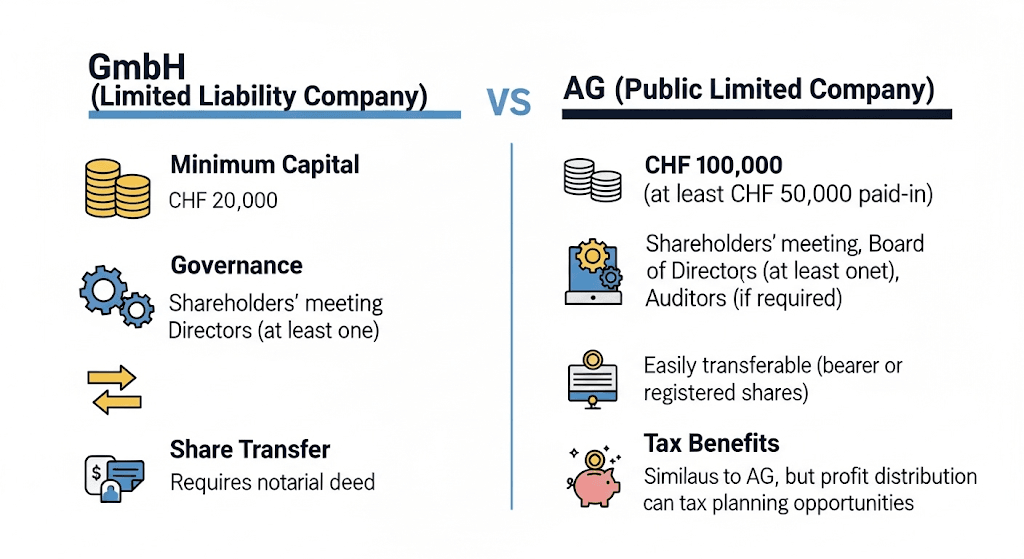
GmbH vs AG is the first real decision you make when forming a Swiss company. It shapes your capital, your privacy, and how easily you can raise money later. So here is the short version. Choose a GmbH when you want a low capital threshold of CHF 20,000. The trade-off is that your name sits in the public register. Choose an AG when you want shareholder privacy and clean share transfers. The capital bar then rises to CHF 100,000. The rest of this guide shows when each one wins. It also shows where most online GmbH vs AG comparisons are quietly out of date.
A Swiss GmbH needs CHF 20,000 in capital, fully paid in. A Swiss AG needs CHF 100,000, of which at least CHF 50,000 must be paid in at formation. Both forms require at least one representative resident in Switzerland.
GmbH vs AG at a glance: capital and what you actually pay
Capital is where the two forms separate first. It also trips up more founders than anything else. A GmbH (Gesellschaft mit beschränkter Haftung) needs CHF 20,000 in share capital. All of it must be paid in before the company exists. An AG (Aktiengesellschaft) needs CHF 100,000 on paper. However, the law only forces you to pay in half. So you can launch an AG with CHF 50,000 of real cash. The other CHF 50,000 stays as a commitment the board can call later.
Do you want to start a business and register a company in Switzerland? Please do not hesitate to contact us for a consultation!
That nuance matters. The headline numbers make the AG look twice as costly as it really is at the start. For a founder weighing GmbH vs AG on cash alone, the gap is CHF 20,000 versus CHF 50,000 up front. It is not CHF 20,000 versus CHF 100,000. Still a real difference, of course. Yet it is smaller than the sticker price suggests.
The 2023 revision of Swiss corporate law also loosened two old rules. Many guides have not caught up. First, you can now hold your share capital in EUR, USD, GBP or JPY instead of francs. The condition is simple: it must be the currency your business actually runs on. Second, the minimum nominal value of a share dropped from CHF 0.01 to just “greater than zero.” As a result, you can slice the cap table far more freely. For the GmbH, the old CHF 100 minimum quota value is gone too. These reforms are small on their own. Together, though, they make both structures more flexible than the pre-2023 advice still floating around online.
| Feature | GmbH (LLC) | AG (stock corporation) |
|---|---|---|
| Legal basis (Code of Obligations) | Art. 772 et seq. | Art. 620 et seq. |
| Minimum capital | CHF 20,000 | CHF 100,000 |
| Paid in at formation | 100% (CHF 20,000) | 50% (CHF 50,000) |
| Shareholders in public register | Yes — names are public | No — kept private |
| Share transfer | Written form + members’ approval | Assignment + entry in share register |
| Management body | Managing officers (often the owners) | Board of directors |
| Swiss-resident representative | Required (one person) | Required (one board member) |
| Foreign ownership | 100% allowed | 100% allowed |
| IPO / public listing | Not possible | Possible |
| Best suited to | Owner-run firms, family businesses, consultancies | Growth startups, investor-backed and larger companies |
Here is the part nobody puts at the top of their GmbH vs AG comparison. It belongs there. In a GmbH, every shareholder is listed by name in the commercial register. Anyone can look them up for free on Zefix, the federal business index. In an AG, by contrast, shareholders are not public. The register shows the board and the auditor. The people who actually own the shares stay off the record.
For many international clients, that single fact settles the GmbH vs AG question. It does so before capital even enters the conversation. Would you rather not have your name searchable next to your Swiss stake? Then the AG is the obvious pick. If transparency does not bother you, the GmbH is fine. For plenty of small owner-run firms, it genuinely does not. In fact, the GmbH’s openness can build trust with Swiss banks and suppliers. They can verify exactly who they are dealing with.
One myth is worth killing here. It is the idea that a Swiss AG gives you anonymous “bearer shares.” It does not. It has not since 1 May 2021. On that date, the Global Forum transparency reform abolished bearer shares for non-listed companies. Any that remained became registered shares by law. So yes, an AG keeps your ownership off the public register. Even so, the company still keeps an internal share register. Beneficial owners must be disclosed to it. Privacy from the public is not the same as secrecy. Be wary of any provider who blurs the two.

Governance and the Swiss-resident requirement
Governance is the next place the two forms diverge. It follows directly from who owns them, and it is the part of the GmbH vs AG decision that founders underestimate. An AG runs on a board of directors. The board holds strategic responsibility and can delegate daily work to managers. A GmbH is simpler by default. The owners themselves run the company, unless the articles hand that job to named people. As a result, the AG suits businesses where ownership and management are separate. The GmbH, meanwhile, fits founders who want to stay hands-on.
Both forms share one rule that surprises newcomers. At least one person who can represent the company must live in Switzerland. For the AG that is a board member. For the GmbH it is a managing officer. Crucially, this rule says nothing about ownership. You can own 100% of either structure from abroad. You simply need a resident signatory. If you do not yet live in Switzerland, you can appoint a local director. Alternatively, a professional representation service covers the gap until you relocate.
The GmbH’s default model puts the owners in charge. Because of that, it carries fewer formal meetings and less paperwork. The AG, by contrast, expects an annual general meeting and tighter board procedure. Neither is hard to run with decent administration. Still, if you value lean governance over investor-facing polish, that difference leans toward the GmbH.
Here I will openly disagree with most of the search results, including pages ranking above this one. You will read everywhere that transferring GmbH quotas requires a notarised deed. That advice is roughly fifteen years out of date. The GmbH law reform took effect on 1 February 2008. Since then, a quota transfer needs only written form under Art. 785 of the Code of Obligations. Notarisation is not required by law. The members’ meeting still approves the transfer by default. The change must also be recorded in the commercial register. But the expensive notary step that older guides describe? It is simply no longer the legal requirement.
That said, the AG is still the smoother vehicle for changing ownership. AG shares move by a written assignment plus an entry in the share register. No members’ resolution is needed, unless the articles impose a transfer restriction. So if you expect investment rounds, employee equity, or a sale, the AG saves friction over time. The GmbH can do all of these things too. It just asks for members’ approval each time, which slows fast-moving cap tables.
Why does this matter for your GmbH vs AG choice? Because the “GmbH needs a notary” myth pushes people toward the AG for the wrong reason. Choose the AG because you want privacy and investor-ready shares. Do not choose it because of a notary bill the law abolished in 2008.
GmbH
AG
The GmbH scores higher on low capital (9 vs 5). The AG scores higher on privacy (9 vs 3), transfer ease (9 vs 5) and investor appeal (9 vs 5). Scores are an editorial summary, not legal ratings.
Does GmbH vs AG change your tax bill? Not the way you think
Now to the question we hear most. The answer surprises people. Your choice between the two forms has almost no direct effect on tax. Both a GmbH and an AG are taxed as capital companies, under identical rules. Take the participation deduction that shelters dividends from qualifying shareholdings. It applies to both forms. So the old claim that “only an AG gets the participation exemption” is simply wrong. What truly moves your rate is the canton you pick, not the letters after your company name.
Combined federal, cantonal and municipal profit tax runs from roughly 11.9% in low-tax cantons such as Zug. In the higher cantons it reaches around 21%. That spread dwarfs any difference the GmbH vs AG decision could create. Consequently, if tax efficiency is your goal, choose the right canton first. Maintain real substance there too, such as an office and local decision-making. Do not agonise over the legal form. For the rates and rules, see our guide to corporate taxation in Switzerland.
One practical, tax-adjacent point favours the AG. Its shares transfer cleanly and its ownership stays private. As a result, it slots into a holding structure more easily later. That is a structuring advantage, though, not a lower rate. Treat tax as a canton decision first. The legal form comes a distant second.
Cost and timeline: what setting up really involves
Beyond the capital itself, both forms carry similar formation costs. The steps are largely the same. You pay a notary to certify the incorporation, plus a commercial register fee. Most founders also add some advisory or representation support. As a rough guide, budget a few thousand francs in fees on top of the capital. The AG sits slightly higher, because of its larger capital handling and stricter setup. These numbers vary by canton and complexity. So treat any single figure you see online with caution.
On timing, a straightforward Swiss company usually registers in about two to four weeks. That holds for a GmbH or an AG, once your documents and capital are in order. Delays rarely come from the company form. Instead, they come from the bank’s capital-deposit account and from document legalisation for foreign founders. So if speed matters, prepare those two things early. Our step-by-step guide to company registration in Switzerland walks through the full sequence. Opening a corporate bank account early removes the most common bottleneck.

GmbH vs AG: a simple way to decide
After all the detail, the decision comes down to a short chain of questions. In our work helping foreign founders set up in Switzerland, three points settle the GmbH vs AG choice in most cases. None of them is the historical trivia that fills longer guides. Walk down this path in order. Stop at the first clear answer.
Question one: if you need private shareholders, choose AG. Question two: if you will raise investment, lean AG. Question three: if low capital and admin matter most, choose GmbH.
Notice what is missing from that path: tax and the notary myth. Neither should drive the GmbH vs AG decision, even though both dominate the online advice. One honest caveat before you commit. A GmbH can be converted into an AG later, so an early choice is rarely permanent. Still, a conversion costs time and fees. So pick for where the business is heading, not only where it sits today. If you are still on the fence, talk to an advisor who registers these companies for a living. That call will save you more than any checklist.
The bottom line
Pick the GmbH if you are building an owner-run company on a low entry cost with lean admin. Pick the AG if privacy, clean share transfers, or future investment outweigh the extra capital. Both shield you behind limited liability. Each one allows full foreign ownership. And either can grow with you. The structure is not what makes a Swiss company succeed. But settling GmbH vs AG for the right reason, on current law rather than recycled advice, means you never unwind the choice later.
Frequently asked questions about GmbH vs AG
Can a foreigner own 100% of a Swiss GmbH or AG?
Is a GmbH or AG cheaper to set up?
Can I convert a GmbH into an AG later?
Are AG shareholders really anonymous?
Does a GmbH or AG pay less tax?
Do GmbH share transfers need a notary?
Which is better for a startup raising investment?
Do I have to live in Switzerland to open a GmbH or AG?
Thinking through GmbH vs AG for your own plans? BMA Business Solutions registers both structures for international founders. We can match the form to where your business is heading. Talk to us about Swiss company registration when you are ready to move.
References
- Swiss Code of Obligations (official consolidated text), Fedlex (opens in new tab)
- Choosing a legal structure: the LLC (GmbH/SARL), Swiss SME Portal (opens in new tab)
- Zefix — Swiss Central Business Name Index (opens in new tab)
- Swiss Federal Tax Administration (ESTV) (opens in new tab)
- Overview of the 2023 Swiss corporate law reform, Grant Thornton (opens in new tab)