
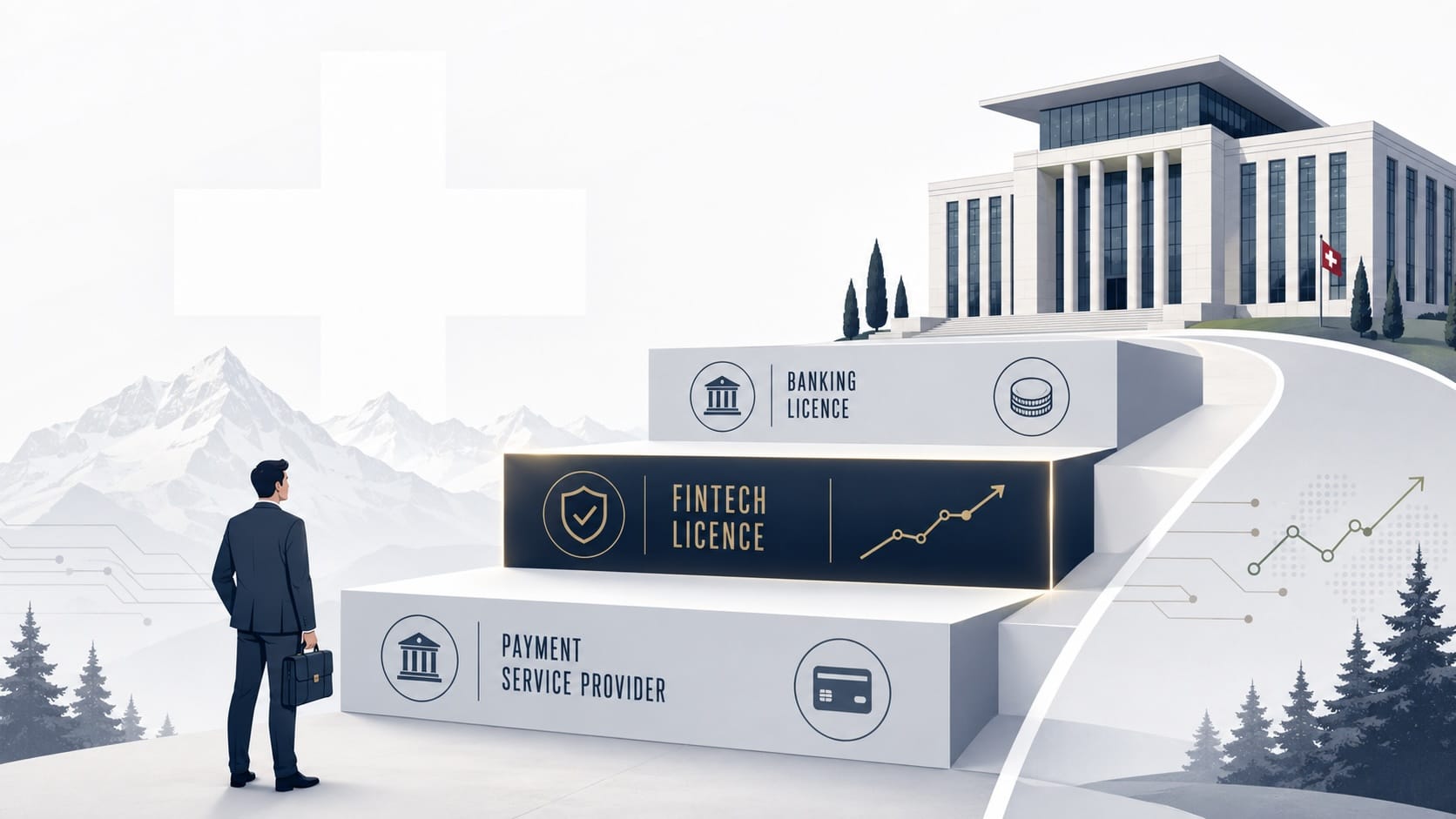
Setting up a Swiss fintech or neobank comes down to one question that founders almost always get wrong at the start: which licence do you actually need? Switzerland does not have a single “fintech licence” that covers everything. It has a three-tier ladder — the sandbox, the FinTech licence, and the full banking licence — and choosing the wrong rung costs months and millions. Pick too light a tier and FINMA shuts you down. Pick too heavy a tier and you burn capital you did not need to raise.
This Swiss fintech licence guide explains the three tiers as they stand in 2026. It covers the exact thresholds and capital each demands, what they cost, and how to decide which one fits the business you are building.
The sandbox allows deposits up to CHF 1 million with no licence. The FinTech licence allows deposits up to CHF 100 million. It requires minimum capital of CHF 300,000 and at least 3% of deposits. A full banking licence requires minimum capital of CHF 10 million.
Why Switzerland for a fintech or neobank?
Before the licensing detail, it is worth being clear about why founders choose Switzerland at all, because it shapes which tier makes sense. Switzerland offers a stable, tech-neutral regulator in FINMA. It has a deep pool of banking and crypto talent. It offers legal certainty around digital assets. And its financial sector is worth roughly 9% of GDP. For a regulated financial business, that combination is hard to match. The country built its fintech rules to lower the barrier to entry without lowering standards. That is exactly why the three-tier ladder exists.
The key concept under it all is the “public deposit.” Under the Swiss Banking Act, taking deposits from the public on a professional basis is regulated. Only licensed banks may do it. You are deemed to act professionally in two cases. One: you keep accepting more than 20 public deposits. Two: you advertise publicly to accept them. The moment client money rests on your balance sheet, you are in deposit-taking territory. Which tier you need then depends on how much you hold, and what you do with it.
The three-tier ladder for a Swiss fintech or neobank
Switzerland’s framework is best understood as three rungs. Each allows more deposit-taking in exchange for more regulation. The table sets out the headline differences; the sections below explain each in turn.
| Feature | Sandbox | FinTech licence (Art. 1b) | Full banking licence |
|---|---|---|---|
| Public deposits allowed | Up to CHF 1m | Up to CHF 100m | Unlimited |
| FINMA licence required? | No | Yes | Yes |
| Minimum capital | None set | CHF 300,000 (and ≥3% of deposits) | CHF 10m fully paid-in |
| Pay interest / lend? | No | No | Yes |
| Deposit insurance? | No | No | Yes (esisuisse, CHF 100k) |
| Best for | Early-stage testing | Payments, custody, neobank wallets | Lending, interest, full bank |

Tier 1: The regulatory sandbox (no licence)
The sandbox is where most Swiss fintech licence journeys should begin. Introduced in 2017, it lets you accept public deposits up to CHF 1 million without any FINMA licence. The number of depositors does not matter. That makes it ideal for testing a product and onboarding early users. You prove the model before you commit to a full licence.
The conditions are strict and strict. The total of public deposits must not exceed CHF 1 million. You must not run an interest-margin business — that privilege belongs to banks. And critically, you must inform every depositor before they deposit. In writing or another text-based form, you tell them you are not supervised by FINMA and that their money is not covered by the Swiss deposit-protection scheme. You also need to be registered in the Swiss company register. And you must comply with anti-money-laundering rules, usually through a self-regulatory team.
The sandbox has one hard edge that founders must plan for. If your deposits exceed CHF 1 million, you must notify FINMA within 10 days. You then apply for a FinTech or banking licence within 30 days. That window is short. So treat the sandbox not as a destination but as a runway. Use it to validate the business. Have your next-tier licence application ready before you hit the ceiling, not after.
Tier 2: The FinTech licence (the “banking licence light”)
The Swiss fintech licence is the rung most real neobanks and payment businesses aim for. This tier is the heart of any plan to set up a fintech or neobank at scale. Created under Article 1b of the Banking Act, it has been open since January 2019. Many founders call it the “banking licence light.” It lets you accept public deposits up to CHF 100 million. That is a hundred times the sandbox ceiling, under lighter rules than a full bank faces.
The trade-off is what you may do with that money. Under a Swiss FinTech licence, deposits must not be invested. They must not bear interest. And they must not be lent out. So you cannot run the interest-margin business that defines a normal bank. So the licence fits payment firms, e-money-style wallets, custody providers and neobanks. Their model is moving and safeguarding money not lending it. Founders often compare it to an Electronic Money Institution (EMI) licence in the UK or EU. But the Swiss version sits within banking law and carries its own contours.
The capital rule is far lighter than a bank’s. You need minimum capital of CHF 300,000, and your capital must amount to at least 3% of the public deposits you hold. The eligible legal form must be a Swiss company limited by shares (AG), a corporation with unlimited partners, or a limited liability company (GmbH). Its registered office and actual business activity must be in Switzerland. The choice between an AG and a GmbH at incorporation has real consequences for governance and capital. We cover it in our guide on choosing between a GmbH and an AG in Switzerland.
One point demands absolute clarity, because it is a client-protection and YMYL issue. Deposits held under a Swiss FinTech licence are not covered by Swiss deposit insurance. They are also not segregated from the bankruptcy estate if the firm fails. You are legally required to inform clients of this before they deposit. Building that this notice into your onboarding is not optional. FINMA treats it as a core condition of the licence.
Tier 3: The full banking licence
If your model requires lending, paying interest, or accepting more than CHF 100 million in deposits, you need a full banking licence. This is the heavyweight tier. It demands at least CHF 10 million in fully paid-in capital. On top of that come full Basel III capital and liquidity rules, a complete governance and risk team, and ongoing FINMA oversight. In return, your depositors gain esisuisse cover up to CHF 100,000. And you can run the full interest-margin business.
For most fintech founders, the full banking licence is a later goal, not a starting point. The capital, the depth of the team and the FINMA burden are rarely realistic for a start-up. The sensible path is usually to grow through the sandbox and the FinTech licence first. You step up to a banking licence only when the lending or interest model really requires it, and the balance sheet can support it.
Which licence does your fintech or neobank need?
Choosing your Swiss fintech licence tier is more mechanical than it first appears. Walk this path and stop at the first tier that fits your model.
If you lend, pay interest or expect over CHF 100 million in deposits, you need a full banking licence. If you only safeguard client money, the FinTech licence fits up to CHF 100 million. If you are testing with under CHF 1 million, start in the sandbox. If you never hold client funds, you may need no banking licence, but check AML and SRO obligations.
Notice the last branch. Many businesses that call themselves fintech never hold client money. They provide software, introductions or advice. If that is you, the deposit-taking rules may not apply at all, though anti-money-laundering obligations and other licences still might. Getting this call right at the start is the best move you make.
What it costs to set up a Swiss fintech or neobank
Cost is where Swiss fintech licence planning matters most, because the fee is the small part. FINMA charges a supervisory levy with a fixed base component of around CHF 3,000, plus a variable element based on your balance sheet and gross income. It estimates the financial and regulatory audit work at roughly CHF 50,000. Those are modest figures next to a banking licence. But they are not the real cost.
The real cost of a Swiss fintech licence sits in the build. Think legal and regulatory advice, the compliance and risk team FINMA expects, and most of all the tech. If you offer fiat payment services with core banking and interbank systems, IT alone can run to hundreds of thousands of francs. In reality, the all-in cost lands between CHF 1.8 million and CHF 3.2 million. That combines capital, advisory, compliance and technology. A full banking licence costs much more again. Budget for the build, not just the badge.

The application process, step by step
The route to a FinTech licence follows a clear order. Knowing it in advance prevents the most costly mistake. That mistake is building the company before you confirm the regulatory path.
- Classify the activity first. Confirm whether you take public deposits, and at what scale. This decides your tier before you spend a franc on incorporation.
- Incorporate the right vehicle. Set up a Swiss AG or GmbH with its registered office and real activity in Switzerland. Fund it to meet the tier’s rule.
- Build the compliance team. FINMA assesses your governance, risk controls, AML processes and management. You cannot just declare them.
- Prepare the application dossier. FINMA’s 2023 guidance sets out the papers a FinTech licence needs; completeness drives the timeline.
- Talk to FINMA. Submit, respond to queries, and show the business is ready to run, not merely planned.
Throughout, the binding constraint is completeness and credibility, not speed itself. A thin or early application invites questions and delay. A complete, well-evidenced one moves. This is why successful founders sequence the regulatory work alongside the company build. They do not treat the Swiss fintech licence as an afterthought.
A cautionary tale: the cost of getting it wrong
The penalty for misjudging deposit-taking is real, not theoretical. In a well-known FINMA case, the company envion AG issued a token that promised repayment to investors. FINMA ruled that this meant taking public deposits without a licence. The company had taken in more than CHF 90 million from tens of thousands of investors. It held no licence for that.
The lesson for any founder is blunt. If client money rests on your balance sheet and you have picked the wrong tier, the regulator can stop the business and unwind it. The tier question at the very start is not paperwork. It is the line between a legal business and an illegal one.
The bottom line for founders
To win a Swiss fintech licence, start with the licence question, not the product. Decide honestly whether you hold client money, how much, and whether you lend or pay interest on it at all. That answer places you on one of three rungs. The sandbox runs up to CHF 1 million. The FinTech licence runs up to CHF 100 million. A full banking licence covers anything above that. Then fund the tier and build the compliance and technology the licence demands. Tell clients what the law requires, and run the regulatory work alongside the build.
Do that, and Switzerland offers one of the most credible homes in the world for a regulated financial business.
Frequently asked questions
What is the Swiss FinTech licence?
How much capital do I need to set up a Swiss neobank?
What is the Swiss regulatory sandbox?
Is a Swiss FinTech licence the same as an EU or UK EMI licence?
Are deposits at a Swiss FinTech-licensed firm protected?
How long does it take to get a Swiss FinTech licence?
Can a foreigner set up a Swiss fintech or neobank?
Planning to set up a Swiss fintech or neobank? BMA Business Solutions helps founders get the most important decision right first — classifying the activity, choosing the tier, incorporating the right Swiss entity, and preparing for FINMA. Start with our guide on choosing between a GmbH and an AG, see how to approach Swiss banking relationships for your business, or read the pillar guide on opening a Swiss bank account as a foreigner. When you are ready, get in touch for a free initial conversation about your project.