
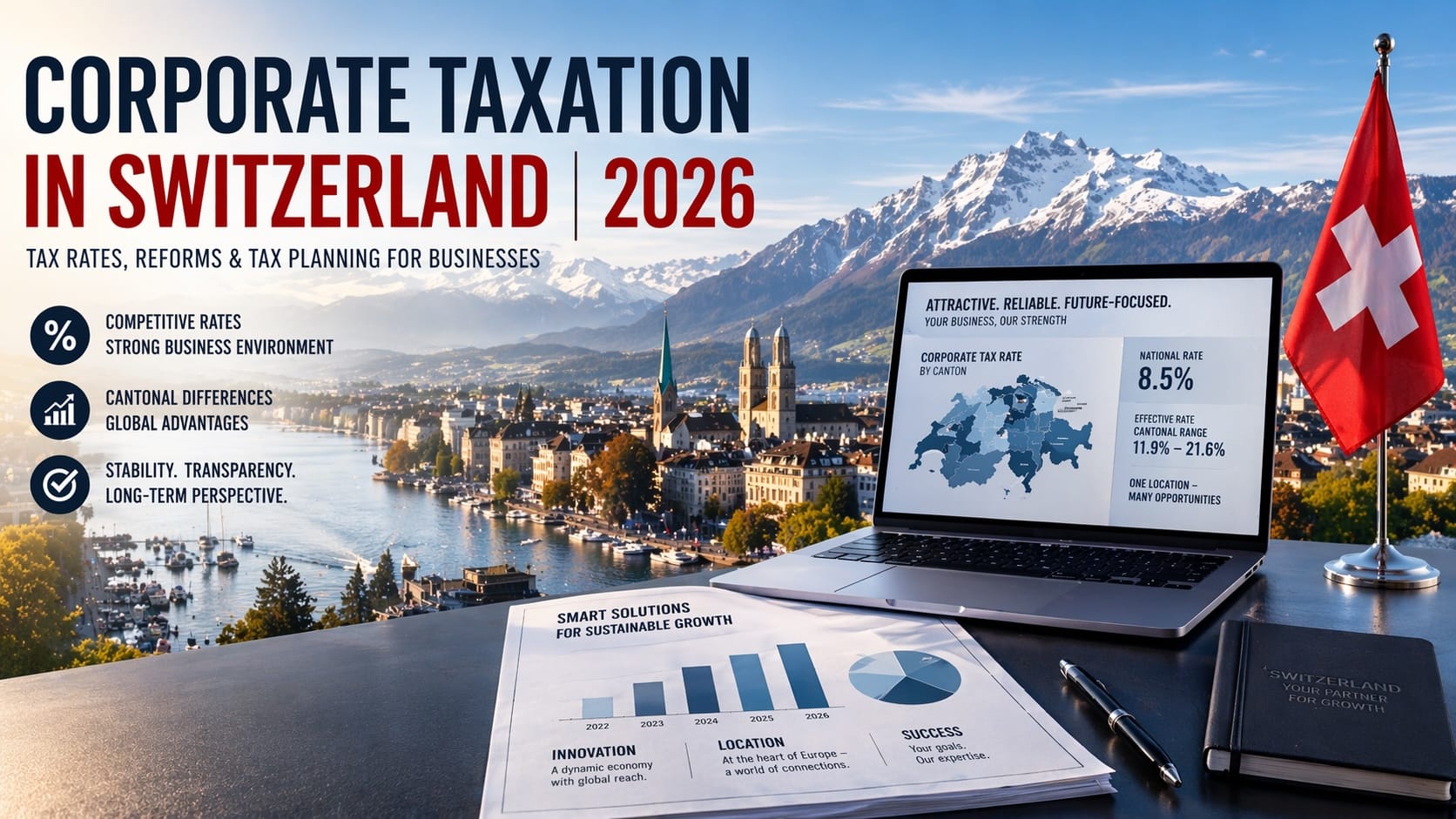
Navigating swiss corporate taxation 2026 requires immediate compliance with the OECD Pillar Two 15% global minimum tax, enforced via Switzerland’s Qualified Domestic Minimum Top-up Tax (QDMTT) and Income Inclusion Rule (IIR). While statutory cantonal rates remain low—Zug at 11.8% and Lucerne at 12.3%—multinationals exceeding €750 million in revenue must pay the difference directly to the Swiss Confederation. Consequently, mastering the broader framework of Swiss corporate tax now depends entirely on optimizing cantonal subsidies, patent boxes, and R&D super-deductions to offset the top-up burden.
Global Minimum Tax
Mandatory OECD Pillar Two floor for MNEs > €750M.
Base Rate (Canton Zug)
Statutory baseline before top-up adjustments.
QDMTT Exposure
Direct federal top-up collected by Switzerland.
The Compliance Shockwave of Swiss Corporate Taxation 2026
The era of simple offshore optimization is completely over. Historically, Switzerland offered unparalleled fiscal predictability. However, the introduction of the OECD Base Erosion and Profit Shifting (BEPS) 2.0 framework has permanently shattered that status quo. Consequently, multinational enterprises (MNEs) now face an incredibly dense regulatory web. Furthermore, the administrative burden has multiplied exponentially. Specifically, companies must now track over 0 distinct data points across their global operations. Therefore, your legacy tax strategies will ultimately fail. Indeed, failing to adapt guarantees severe financial penalties.
Here is the thing. Old tax rulings are functionally void. Specifically, structures established before the TRAF (Tax Reform and AHV Financing) regulations require immediate overhauls. Consequently, chief financial officers must aggressively audit their Swiss entities. Namely, you must determine your exact exposure to the new top-up rules. Ultimately, ignorance is no longer a defensible audit position.
Breaking Down the Two-Column Impact
You must visualize this paradigm shift clearly. Specifically, the juxtaposition between the legacy framework and the 2026 reality is jarring. Therefore, carefully examine the structural differences outlined below. Indeed, understanding this dichotomy is mandatory.
The Pain: Pre-2024 Legacy Models
- Relying purely on statutory cantonal rate shopping.
- Ignoring consolidated global revenue thresholds.
- Minimal intra-group transfer pricing documentation.
- Capitalizing entities purely for tax base erosion.
- Assuming blanket protections under old Double Taxation Treaties.
The Reality: 2026 Operational Model
- Mandatory 15% effective tax rate (ETR) floor enforcement.
- Extensive GloBE Information Return (GIR) mandatory filings.
- Heavy reliance on Qualified Refundable Tax Credits.
- Strict adherence to OIMin Article 2 static references.
- Digital compliance exclusively via the Swiss OMTax portal.
The Pillar Two Reality: QDMTT and IIR Enforcement
Switzerland did not simply surrender its fiscal sovereignty to the OECD. Instead, the Federal Council cleverly activated the Qualified Domestic Minimum Top-up Tax (QDMTT) effective January 1, 2024. Subsequently, the Income Inclusion Rule (IIR) fully took effect in 2025. Therefore, the architectural framework for 2026 is fully locked in. Namely, if your company operates in a low-tax canton like Zug, the Swiss government aggressively collects the top-up tax locally. Thus, foreign jurisdictions cannot tax your Swiss profits. This defensive maneuver keeps the capital strictly inside Swiss borders. This shift profoundly impacts strategies during initial company registration in Switzerland, requiring immediate structural foresight.
Nevertheless, the financial pain for your enterprise remains absolutely identical. You are still legally obligated to pay the 15% minimum. Furthermore, the Swiss constitutional amendment passed by public vote explicitly authorizes this collection. Consequently, there is no legal loophole to bypass the federal mandate. Indeed, fighting the assessment in court is a guaranteed loss.
The June 2026 Reporting Trap
The compliance clock is loudly ticking. Specifically, the very first GloBE Information Return (GIR) for standard calendar year companies is officially due by June 30, 2026. Therefore, you have exactly 18 months from the end of the first transitional year to achieve full compliance. Furthermore, this requires mandatory entity registration on the centralized Swiss OMTax portal. Consequently, corporate tax departments are currently drowning in chaotic data mapping exercises. Ultimately, procrastination will inevitably trigger catastrophic compliance failures.
Analyzing the Cantonal Rate Shift
The fierce internal competition between Swiss cantons has drastically evolved. Previously, cantons fought a localized “race to the bottom” regarding headline corporate income tax (CIT) rates. However, the rigid 15% floor totally neutralizes this tactic for large MNEs. Specifically, any statutory rate sitting below 15% instantly triggers the QDMTT mechanism. For instance, Zug currently sits at a highly attractive 0%. Therefore, a highly profitable global entity there faces a mandatory 3.2% top-up penalty. Consequently, the fiscal divide between urban financial centers and central Switzerland is technically shrinking for billion-dollar corporations.
Meanwhile, high-tax cantons like Zurich (19.7%) and Bern (21.0%) remain largely unaffected by the top-up itself. Therefore, companies located there are already paying above the OECD threshold. Consequently, these cantons are focusing heavily on administrative ease rather than rate cuts. Indeed, the battleground has completely shifted.
Why Zug and Lucerne Still Matter
Despite the aggressive minimum tax implementation, central Swiss cantons remain incredibly attractive. Namely, the minimum tax strictly applies only to groups with global revenues exceeding €750 million. Therefore, smaller international enterprises and domestic SMEs still fully benefit from Zug’s 11.8% and Lucerne’s 12.3% base rates. Furthermore, low-tax cantons are aggressively deploying alternative cash incentives. Thus, the actual cash tax paid can still be legally optimized. Geography undoubtedly still dictates your baseline fiscal health.
The Mechanics of the Domestic Top-Up Tax
Understanding the strict mathematics behind the Swiss top-up is absolutely critical. First, you must meticulously calculate your GloBE income. Next, you meticulously compute your covered taxes. Then, you divide the covered taxes by the GloBE income to determine your true Effective Tax Rate (ETR). If this ETR falls below 15%, the QDMTT instantly activates. Therefore, the Swiss Federal Tax Administration (SFTA) issues a swift additional assessment.
Instead, it relies heavily on financial accounting standards like IFRS or US GAAP. Consequently, major deferred tax liabilities will drastically impact your final bill. Indeed, the January 2026 OECD Side-by-Side package clearly outlines the recapture rules applicable to deferred tax liabilities. Therefore, your accounting team must reconcile dual ledgers simultaneously.
Safe Harbours and the Simplified ETR
Fortunately, the OECD initially provided a temporary lifeline. Specifically, the Transitional CbCR Safe Harbour allows qualified companies to avoid full GloBE calculations entirely. Namely, if your simplified ETR meets the specific yearly threshold, the top-up tax is legally deemed zero. However, this safe harbour is rapidly phasing out. Therefore, by late 2026, most MNEs must transition directly to the permanent safe harbour rules or perform the complete, grueling calculation. Ultimately, relying on transitional relief is a very short-sighted corporate strategy.
Cantonal Subsidy Substitutes: The New Battleground
Because cantons can no longer slash headline rates, they are aggressively weaponizing the tax base. Specifically, they are introducing incredibly generous super-deductions. Therefore, your tax strategy must rapidly pivot from rate shopping to deliberate base erosion. Furthermore, the Swiss government actively encourages this behavior under the TRAF regulations. Namely, these measures are internationally accepted and fully OECD-compliant. Consequently, companies that strategically restructure their operations to maximize these deductions will easily maintain their competitive edge.
Indeed, this is exactly where expert tax architects earn their premium fees. You must locate the cantons offering the highest base reductions. Subsequently, you must align your physical corporate substance to qualify for those specific local incentives.
The R&D Super-Deduction Strategy
Research and development is now your absolute strongest fiscal shield. Specifically, numerous Swiss cantons offer an R&D super-deduction of up to 150% on qualifying personnel expenses. Therefore, heavily investing in local Swiss innovation drastically reduces your taxable net profit. Furthermore, this specific deduction is explicitly designed to withstand Pillar Two scrutiny. Namely, it lowers your statutory profit without artificially reducing your covered taxes in a non-compliant manner. Consequently, tech and pharmaceutical giants are currently relocating their primary R&D hubs to cantons offering the maximum multiplier.
Leveraging the Swiss Patent Box
The patent box regime remains another incredibly powerful structural tool. Specifically, net profit derived from domestic and foreign patents can be taxed at a substantially reduced rate. In fact, cantonal tax on qualifying intellectual property income can be reduced by a staggering 90%. Therefore, properly segregating your IP revenue is absolutely vital. Moreover, the OECD nexus approach strictly dictates that the relief must correlate directly with the R&D expenses incurred to develop the IP. Consequently, meticulous tracking of IP-related expenditures is completely mandatory. Ultimately, a fully optimized patent box can successfully offset millions in potential top-up taxes.
Capital Tax Step-Ups and Reductions
Switzerland uniquely levies an annual tax on corporate equity. However, clever legal structuring completely eliminates this localized burden. Specifically, many cantons actively allow corporate income tax to be fully credited against the capital tax. Therefore, highly profitable operational entities effectively pay zero capital tax. Furthermore, the taxable capital relating directly to participations, patents, and intra-group loans can be heavily discounted. For instance, the Canton of Zug systematically ignores 98% of equity tied to qualifying participations. For multinationals evaluating restructuring under Swiss company law, understanding these exact cantonal capital tax step-ups is mandatory.
| Strategic Element | Legacy Approach (Pre-2024) | Current Reality (2026 Focus) |
|---|---|---|
| Primary Focus | Lowest statutory cantonal rate (e.g., Zug, Schwyz). | Maximizing R&D super-deductions and Patent Box. |
| Top-Up Tax (QDMTT) | Non-existent. Base erosion to 8-10% ETR was common. | Hard floor of 15% ETR globally enforced locally. |
| Capital Tax Strategy | Accepted as a minor, unavoidable cost of doing business. | Aggressive structuring to achieve 100% crediting against CIT. |
Thus, optimizing your balance sheet composition is just as important as managing your P&L statement. You must deliberately engineer your equity footprint. Indeed, passive holding companies are punished, while active holding structures are heavily rewarded.
The Mathematical Reality of Federal Deductibility
The Swiss Direct Federal Tax operates on a highly unique, self-reducing mechanism. Specifically, the statutory federal rate is technically 8.5%. However, this tax is strategically levied on the after-tax profit. Therefore, the tax itself is a fully deductible business expense. Consequently, the effective pre-tax federal rate is mathematically lower. We can calculate this using a strict algebraic formula.
(Formula computation: T = 0.085 / 1.085 * P ≈ 0.07834 * P)
Thus, the true federal corporate burden is approximately 7.83%. Furthermore, this cascading deductibility applies identically at both the cantonal and communal levels. Ultimately, this built-in deductibility is the hidden engine driving Swiss fiscal efficiency.
Profit repatriation remains a massive, ongoing hurdle. Specifically, Switzerland heavily imposes a punitive 35% federal withholding tax on all dividend distributions. Therefore, carelessly moving cash upward to a foreign parent company destroys vital shareholder value. Furthermore, this aggressive tax also applies to constructive dividends and hidden profit distributions. Consequently, informal financial arrangements between related parties are incredibly dangerous. Namely, if a routine audit uncovers off-market pricing, the 35% tax is immediately applied retroactively. Ultimately, strictly managing your dividend streams is a non-negotiable compliance priority.
In my experience, too many foreign executives assume Swiss funds are freely liquid. They are absolutely not. You must navigate the withholding barriers first.
Optimizing Double Taxation Treaties (DTTs)
Thankfully, Switzerland boasts an extensive, robust network of over 100 Double Taxation Treaties. Therefore, the 35% rate is rarely the final financial burden. Specifically, astute MNEs can utilize the treaty network to reduce the withholding rate to 15%, 5%, or even 0%. Furthermore, the bilateral agreement with the European Union provides total exemption for qualifying parent-subsidiary structures. However, you must proactively apply for this relief using Form 823B strictly before distributing the dividend. Consequently, administrative negligence will rapidly result in millions of trapped capital. Indeed, strategic treaty shopping requires extreme operational precision.
The Operational Mandate: OMTax and GIR
Flawless execution is everything. The Swiss government has officially launched a centralized digital portal called OMTax. Specifically, this platform securely handles all Pillar Two registrations and complex filings. Therefore, manual paper filings are strictly and permanently prohibited. Furthermore, registration is legally mandatory even if your group qualifies for a transitional safe harbour. Consequently, you must formally designate a taxable constituent entity within Switzerland to act as the primary filer.
Namely, this specific entity assumes total legal liability for the group’s domestic compliance. Ultimately, selecting the wrong entity structure will severely complicate your inevitable audit defense. You must choose an entity with deep administrative resources.
Mapping the 150 Data Points
Your current ERP system is completely inadequate. Specifically, calculating the precise GloBE ETR requires granular data that standard accounting software routinely ignores. Therefore, implementing enterprise-grade tax engines is now mandatory. Furthermore, you must continuously reconcile differences between local statutory accounts and consolidated IFRS/GAAP figures. Consequently, your tax and IT departments must collaborate continuously. Indeed, internal data silos will guarantee a failed filing by the June 2026 deadline. Thus, rapid automation is your only viable path forward.
Strategic Moves for Q3 and Q4 2026
Preparation must heavily accelerate immediately. First, you must rapidly conduct a comprehensive gap analysis of your current reporting capabilities. Second, model the exact financial impact of the QDMTT on your specific Swiss footprint. Next, aggressively pursue localized cantonal subsidies to offset the anticipated top-up. Furthermore, engage proactively with the cantonal tax authorities. Specifically, engaging in specialized expert business consulting to secure advance tax rulings remains a fundamental cornerstone of fiscal certainty.
Therefore, you must secure binding agreements on your R&D and patent box qualifications strictly before the fiscal year ends. Ultimately, proactive engagement successfully prevents retrospective disaster.
Auditing Your Existing Structure
Corporate complacency is your absolute biggest enemy. Namely, legal structures built in 2019 are functionally obsolete today. Therefore, conduct a hostile, independent audit of your own transfer pricing policies. Furthermore, evaluate whether your actual Swiss substance fully aligns with your reported profits. Consequently, empty shell companies will face immediate, harsh sanctions under the new anti-abuse doctrines. Indeed, physical office space, local personnel, and genuine economic activity are the new unassailable prerequisites for Swiss tax benefits.
Frequently Asked Questions (FAQ)
No. The Pillar Two minimum tax strictly applies only to multinational enterprise groups with a consolidated annual global revenue exceeding €750 million. Therefore, domestic SMEs and smaller international groups remain fully subject to the standard statutory cantonal rates, which can be as low as 11.8% in Zug.
For companies operating on a standard calendar fiscal year, the very first GloBE Information Return (GIR) is officially due on June 30, 2026. Furthermore, this filing must be executed electronically via the centralized Swiss OMTax application. Consequently, missing this deadline will immediately result in severe financial penalties.
The patent box regime allows a significantly reduced cantonal tax rate on net profit derived directly from qualifying intellectual property. Specifically, depending heavily on the canton, this specific revenue can enjoy a tax relief of up to 90%. Therefore, it remains a highly effective, strictly OECD-compliant method to lower your overall effective tax rate.
Yes. In Switzerland, all corporate income and capital taxes paid are treated strictly as fully deductible business expenses. Specifically, the 8.5% federal direct tax is calculated solely on the profit after tax. Consequently, the effective pre-tax federal tax rate is mathematically reduced to approximately 7.83%.
Companies cannot technically “avoid” it, but they can legally reduce or completely eliminate it by leveraging Double Taxation Treaties (DTTs) or the Swiss-EU agreement. Therefore, qualifying parent companies must proactively file the appropriate relief forms (such as Form 823B) to strictly authorize a notification procedure, legally bypassing the cash deduction entirely.
References & Citations
- OECD (2026). Global Anti-Base Erosion Model Rules (Pillar Two).
- Swiss Federal Council (2026). Ordinance on the Minimum Taxation of Large Corporate Groups (OIMin).
- Deloitte Switzerland (2025). Pillar Two Registration in Switzerland and OMTax Application.
- PwC Switzerland (2025). BEPS 2.0 | Preparing for the New Global Tax System.
- Worldwide Tax Summaries (2026). Switzerland Corporate Income Tax Breakdown.