

The lowest income tax countries in Europe can hand a high earner back a six-figure sum every year — but only if you pick the right one for how your income is actually structured. That last part is where most guides fail. A €300,000 salary points to one country. The same sum paid as dividends points elsewhere. A €3 million passive portfolio points to a third. So this guide does two things. First, it ranks the genuinely low-tax European options for 2026, with current rates. Then it shows which one fits which kind of high earner — because the lowest headline rate is rarely the lowest actual bill.
Monaco has no income tax, and Cyprus non-doms pay 0% on dividends. Bulgaria has a 10% flat tax. Greece offers a €100,000 flat tax on foreign income. Italy raised its flat tax to €300,000 in 2026.
How to read the lowest income tax countries in Europe as a high earner
Consider a couple we will call Martin and Elena, on €300,000 a year in Frankfurt. After income tax, the solidarity surcharge and uncapped social contributions, roughly €135,000 vanishes annually. Almost half their income, gone before they save a cent. Their question is the one this guide answers: is there a smarter place to live in Europe? The answer is yes, and the right answer depends entirely on how they earn that €300,000.
So here is the lens that matters. The lowest income tax countries in Europe split into three very different groups, and each suits a different profile:
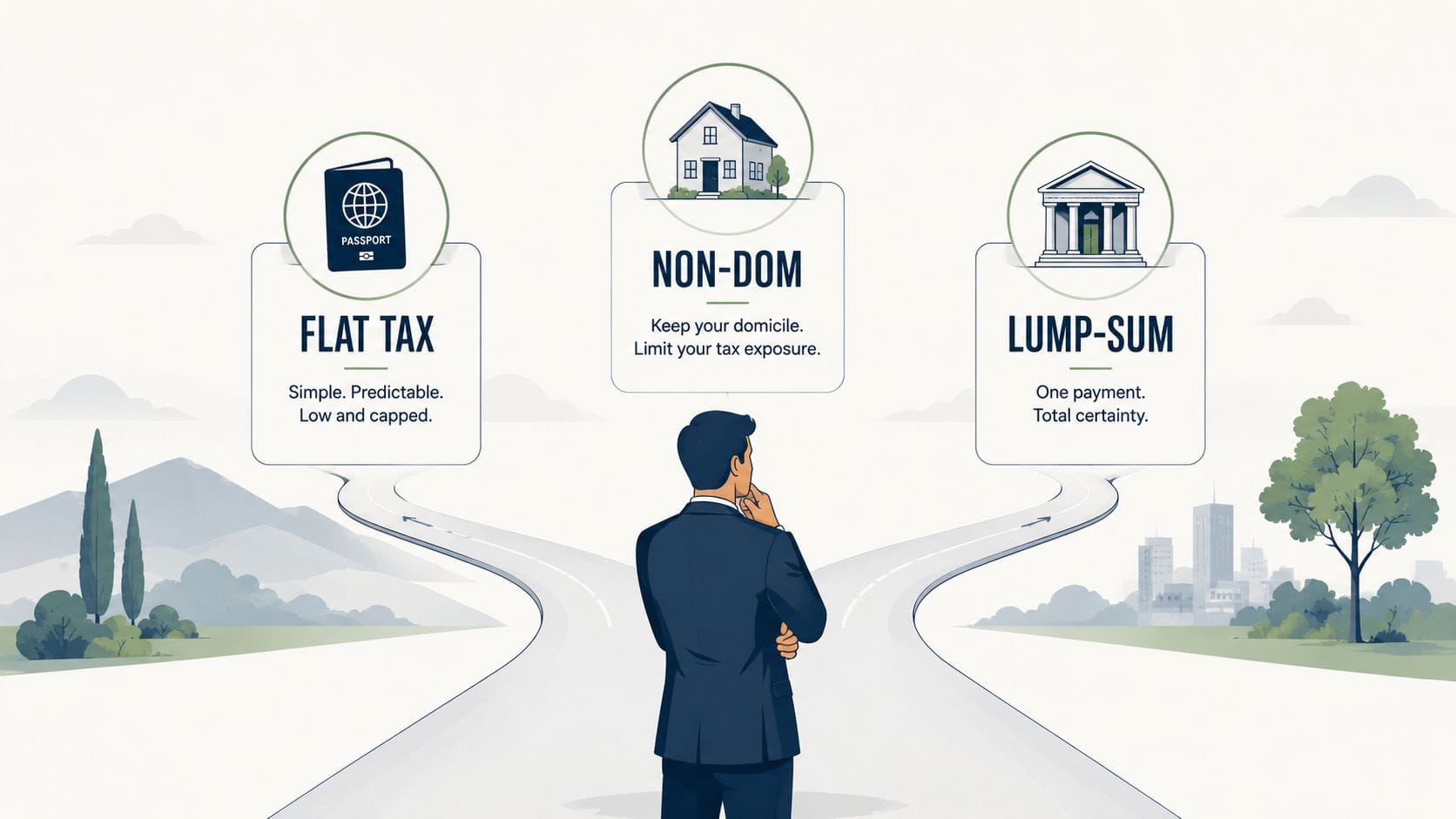
- Flat-rate countries tax all your income at one low percentage. Best when your money is earned — salary, consulting, an operating business.
- Special non-dom and lump-sum regimes cap or exempt foreign income. Best when your wealth sits abroad as dividends, interest or capital gains.
- Zero-tax micro-states charge nothing on income, but the cost of living is the real price. Best only at very high incomes.
Keep that split in mind, because it is the whole game. A flat 10% looks worse than a €100,000 cap until you do the maths on a large enough income — and far better on a smaller one. Now let us take each group in turn.
The flat-tax countries: simplest for earned income
Among the lowest income tax countries in Europe, this group is the simplest. Each applies a single low rate to almost everything you earn. There is no clever structuring and no foreign-versus-local distinction — just a flat percentage. That simplicity is the appeal, especially if your income is active rather than passive.
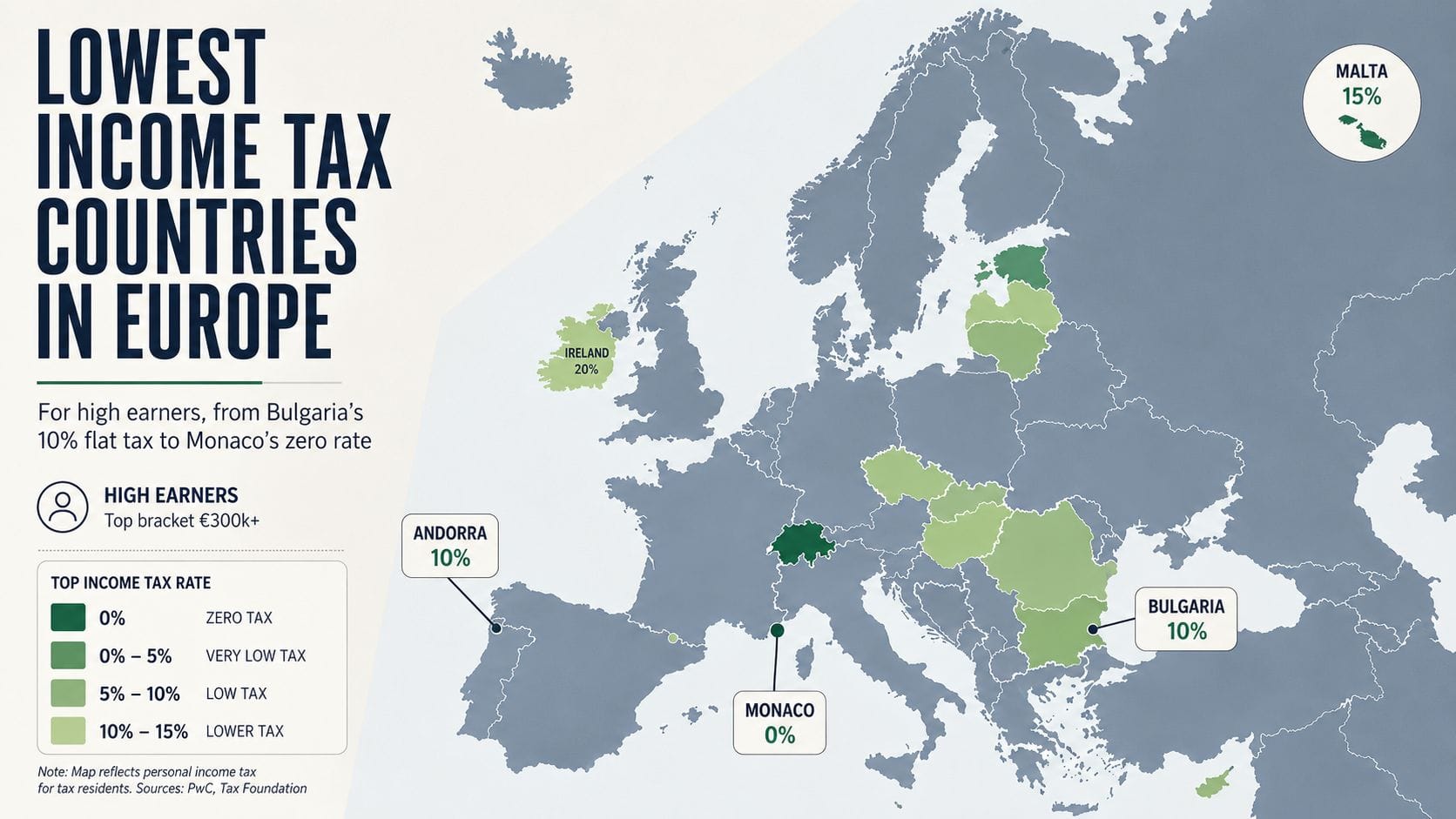
Bulgaria leads with a 10% flat tax, the lowest standard rate in the EU, applied broadly across income types. Romania matches it at 10%, with dividends taxed at just 8% and social contributions capped. Hungary sits at a stable 15% flat rate. Outside the EU, Andorra caps personal income tax at 10%, with the first slice tax-free, while keeping a polished Alpine lifestyle. The Czech Republic runs a 15% rate (23% above roughly €80,000) and is a favourite of freelancers. Estonia taxes distributed dividends at 22% — rising to 24% in 2026 — but levies nothing on profits a company retains and reinvests.
For Martin and Elena, Bulgaria is instructive. A 10% flat tax on €300,000 of earned income means roughly €30,000, versus the €135,000 they lose in Germany. That is a six-figure annual saving for the price of simplicity. The catch is residency substance, which we will come back to.
The special regimes: built for wealthy newcomers
This is the group the old “top 10” lists tend to miss. Yet for genuine high earners, the lowest income tax countries in Europe are often these. They are countries with a high headline rate but a generous special regime underneath. Several high-tax European states cap or exempt foreign income for new residents. The headline rate looks scary; the regime is not.
Cyprus is the standout. Become a tax resident as a “non-dom,” and you pay 0% on dividends, interest and rental income for 17 years. High-earning employees also get a 50% exemption on employment income above €55,000. Structure a €300,000 income as dividends from a company, and your personal tax bill falls close to zero. You add only a small health levy, around 2.65%, capped near €4,700 a year. For passive, dividend-based income, few places in Europe beat it. Do note that Cyprus faces growing EU scrutiny, so the rules merit watching.
Greece offers a non-dom lump sum: €100,000 a year covers all your foreign income, plus €20,000 for each family member, for up to 15 years. Italy mirrors this, though it just got pricier. As of 1 January 2026, its “regime dei nuovi residenti” flat tax rose from €200,000 to €300,000 a year on all foreign income, with the per-family-member charge doubling to €50,000. Existing residents are grandfathered at their old rate. Italy now clearly targets the ultra-wealthy: at €300,000 flat, the regime only pays off once your foreign income comfortably exceeds €1 million.
Switzerland takes a different route with lump-sum taxation, where wealthy non-working residents are taxed on their living expenses rather than their worldwide income. Malta uses a remittance system: foreign income you do not bring into the country is not taxed, while remitted income is taxed at 15% with an annual minimum. Portugal, meanwhile, closed its famous NHR scheme; its replacement, IFICI, gives a 20% flat rate but only to specific scientific and innovation roles, so it is no longer the broad pension-and-passive haven it once was.
Zero-tax Monaco: real, but only for the very wealthy
Monaco is the original tax haven. There is no personal income tax, no capital gains tax and no wealth tax (French nationals aside). The catch is not the tax — it is the cost of being there. Rent for a modest two-bedroom apartment routinely tops €10,000 a month. So Monaco only makes financial sense once your income runs well into seven figures. For a family on €300,000, the cost of living would swallow most of the tax saving. It belongs on any list of the lowest income tax countries in Europe, but be honest about who it is for.
| Country | Standard top rate | High-earner regime (2026) | Best suited to |
|---|---|---|---|
| Bulgaria | 10% flat | — | Earned income, simplicity |
| Romania | 10% flat | 8% on dividends | Remote workers, low cost of living |
| Hungary | 15% flat | — | Stable, predictable flat tax |
| Andorra | 10% cap | — | Low tax plus Alpine lifestyle |
| Czech Republic | 15% (23% over ~€80k) | — | Freelancers, contractors |
| Estonia | 22% (24% in 2026) | 0% on retained profits | Founders reinvesting profit |
| Cyprus | 0–35% | Non-dom: 0% dividends/interest, 17 yrs | Dividend and passive income |
| Malta | 0–35% | 15% on remitted foreign income | Foreign passive income kept offshore |
| Greece | up to 44% | €100k flat on foreign income | HNW individuals, large foreign income |
| Italy | up to 43%+ | €300k flat on foreign income | Ultra-wealthy, €1m+ foreign income |
| Switzerland | ~22–45% (cantonal) | Lump-sum on expenditure | Wealthy non-working residents |
| Monaco | 0% | — | Very high income and net worth |
Here is what the rate tables never tell you. A low tax rate is worthless if your move is not real. Even the lowest income tax countries in Europe cannot help a relocation that exists only on paper. Tax authorities in high-tax countries fight hard to keep you, and a paper move invites challenge. To make any of these regimes stick, you generally need genuine substance: a real home, real time spent in the country, and a clean break from your old tax residence. Half-measures get unwound, sometimes years later, with penalties.
Banking is the practical chokepoint. Opening accounts as a freshly arrived non-resident — and proving the source of substantial wealth — is harder than the brochures suggest, especially under today’s compliance rules. In our work with internationally mobile clients, this is where plans most often stall: the tax structure is sound, but the banking and documentation lag behind. Sort the residency and the bank account early, in parallel with the tax planning, not after it. Our guide on how to open a bank account as a foreigner covers the compliance side in detail, and for company-based structures the choice of GmbH or AG can shape how dividends are taxed.
Which low-tax country fits your income?
Forget the single “best” country. Among the lowest income tax countries in Europe, the right one falls out of how you earn. Walk this path and stop at the first match.
For dividends or passive income, consider Cyprus or Malta. For earned income, a flat-tax country like Bulgaria, Romania or Hungary. For foreign income above one million euros, the Greek, Italian or Swiss lump-sum regimes. For the very wealthy focused only on tax, Monaco.
Back to Martin and Elena. If their €300,000 is salary, Bulgaria’s 10% is the obvious move. If they can route it as dividends through a company, Cyprus non-dom takes them close to zero. Italy and Monaco, despite the headlines, are simply the wrong tools at their income level. That is the difference between reading a rate table and reading your own situation.
The bottom line
The lowest income tax countries in Europe genuinely let high earners keep far more of what they make — Germany’s €135,000 bill can shrink to €30,000 or even near zero. But the winner is never the lowest number on a list. It is the regime that fits your income type, that you can move to for real, and that you can bank in. Get those three right, and the saving compounds for decades. Get them wrong, and a tax authority eventually sends the bill back, with interest.
Frequently asked questions
Which European country has the lowest income tax?
What is the best low-tax country in Europe for a €300,000 income?
How much is Italy’s flat tax for new residents in 2026?
Is Cyprus non-dom status still worth it?
Can I just register in a low-tax country and keep living elsewhere?
What happened to Portugal’s NHR scheme?
Planning a move to one of the lowest income tax countries in Europe? BMA Business Solutions helps high earners structure the relocation properly — residency, company structure and banking together, so the saving actually holds. Read our guide to relocating to Switzerland or our overview of corporate taxation in Switzerland, then get in touch to map your own situation.
References
- PwC Tax Summaries — Italy: taxes on personal income (flat-tax regime) (opens in new tab)
- PwC Tax Summaries — Cyprus: non-domicile rules (opens in new tab)
- PwC Tax Summaries — Greece: alternative taxation of foreign-source income (opens in new tab)
- European Commission — Personal taxation across the EU (opens in new tab)
- PwC Tax Summaries — Bulgaria: 10% flat tax (opens in new tab)